
Induction Cooktop Wattage Guide: Power Usage, Electricity Costs, and Buying Tips
Choosing an induction cooktop is not just about finding a sleek appliance that boils water quickly. You also need to […]
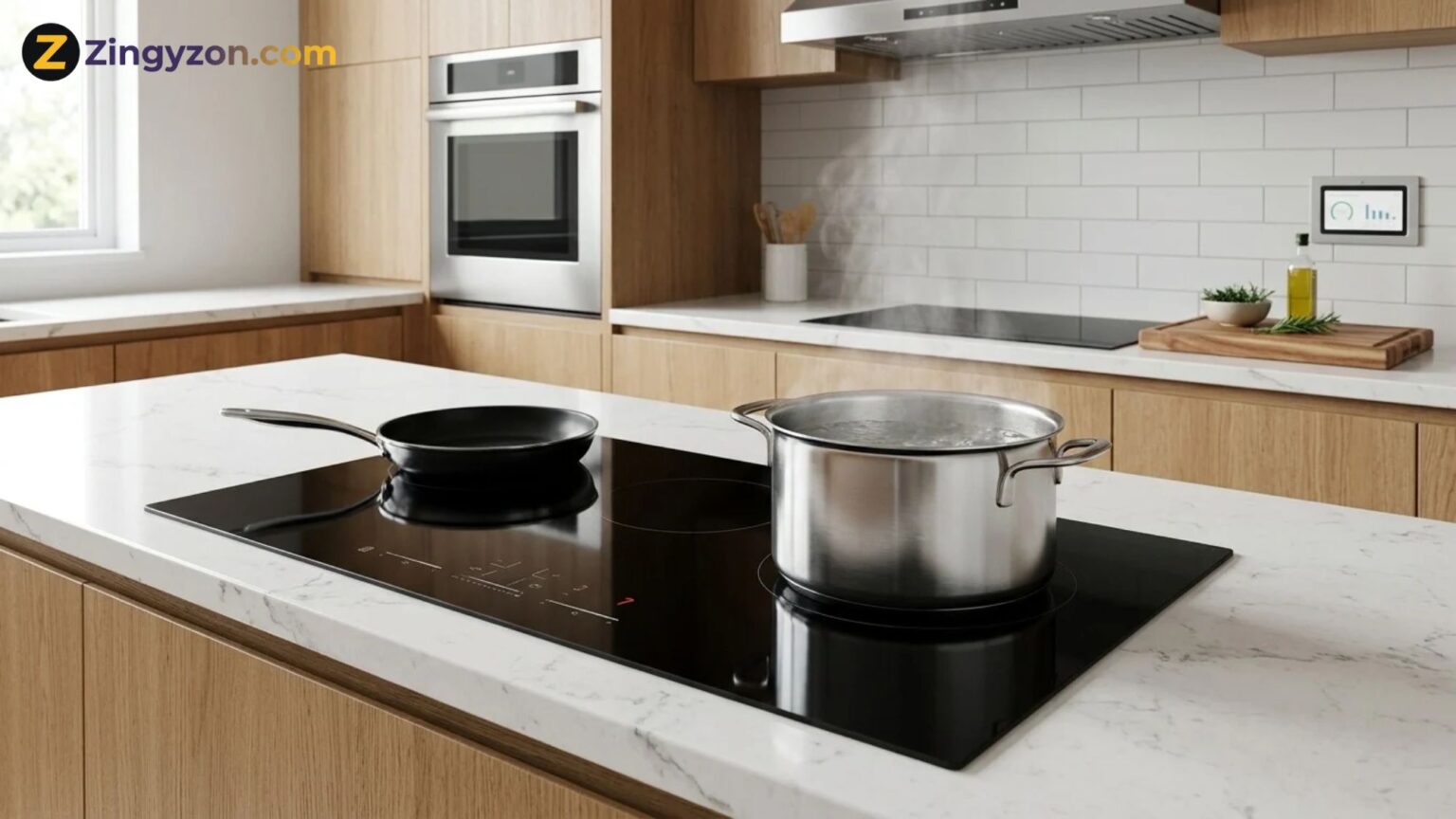
Choosing an induction cooktop is not just about finding a sleek appliance that boils water quickly. You also need to understand how many watts it uses, whether your electrical setup can handle it, and what running it may cost. This induction cooktop wattage guide explains those details in everyday language, whether you are shopping for a portable burner or planning a built-in kitchen upgrade.
Most portable induction cooktops sold for standard U.S. outlets have maximum ratings around 1,200–1,800 watts, while individual cooking zones on built-in units may deliver considerably more power. Those numbers describe potential electrical demand, not necessarily what the appliance consumes every minute. Your cooking level, cookware, and recipe all affect actual energy use.
What Is Induction Cooktop Wattage?
Wattage measures the rate at which an appliance uses electrical power. A 1,800-watt induction burner can draw up to about 1.8 kilowatts when operating at its rated maximum, subject to its controls and electrical design. At a lower heat setting, average demand is usually lower.
Induction works by producing a changing magnetic field that heats compatible cookware directly. Unlike a traditional electric coil, it does not first need to heat an exposed resistance element. That direct heating is a major reason induction can cook efficiently.
Three terms are worth keeping separate:
- Watts (W): Instantaneous power used or rated for a cooking zone.
- Kilowatts (kW): Watts divided by 1,000; 1,800 W equals 1.8 kW.
- Kilowatt-hours (kWh): Energy consumed over time, which is what electricity bills commonly measure.
A high wattage number alone does not mean the cooktop will create a high monthly bill. Cooking time matters just as much.
How Many Watts Does an Induction Cooktop Use?
The answer depends on whether the model is portable or built in, how many cooking zones it has, and whether a power-boost feature is active. The following ranges are broad shopping references, not fixed ratings for every product.
| Induction cooktop type | Illustrative wattage | Common use |
|---|---|---|
| Single portable burner for U.S. outlets | 1,200–1,800 W maximum | Small kitchens, extra cooking station |
| Smaller built-in cooking zone | Roughly 1,200–1,800 W | Sauces, small pans, gentle cooking |
| Medium or large built-in zone | Roughly 1,800–3,700 W, sometimes more on boost | Frying, boiling, large cookware |
| Full multi-zone built-in cooktop | Approximately 6,000–11,600 W connected load on some models | Multiple pans and family meals |
The whole-appliance connected load is not the same as the sum you should expect to draw throughout dinner. Many units manage output between zones to stay within their designed electrical limits.
Look for the manufacturer’s electrical specifications rather than relying on an advertised “high-power” claim.
Portable Induction Cooktop Wattage: Is 1,800 Watts Enough?
For many households, a 1,800-watt portable induction cooktop is a practical choice. It can handle everyday tasks such as boiling pasta water, preparing eggs, cooking vegetables, and heating soups. It also provides extra cooking space during holidays or kitchen renovations.
Smaller units may be sufficient for simple meals, but maximum wattage does not tell the whole performance story. Pan size, control precision, and how steadily a cooker maintains low heat are equally useful considerations.
A portable cooktop designed for a U.S. 120-volt outlet must be used according to its stated electrical requirements. At high output, it may place a substantial load on the circuit, especially if a toaster oven or microwave is running nearby.
For readers setting up compact kitchens, our guide to best home appliances for small apartments explains where a portable induction burner can fit into a space-saving appliance plan.
What About 2,000-Watt or 3,500-Watt Portable Models?
Not all portable induction cookers are designed for the same voltage or market. Higher-power commercial or international models may require a different supply, outlet, or dedicated circuit. You cannot assume a 3,500-watt model will operate safely from a standard U.S. household receptacle.
Always check the model’s voltage, amperage, plug configuration, and installation instructions before purchasing.
Built-In Induction Cooktop Wattage and Power Sharing
A built-in induction cooktop typically has three to five cooking zones, sometimes with flexible areas for larger pans. Each zone has its own rated output, while the appliance also has a total connected-load specification.
For example, a medium zone might be rated at 2,100 watts and temporarily reach 3,000 watts with boost. A larger zone may have an even higher peak rating. Actual specifications differ significantly across brands and models.
Some cooktops share available power between neighboring zones. Turning on boost for one pan may reduce the available output for another. That is normal power management, not necessarily a malfunction.
A 30-inch built-in cooktop may have a different supply requirement than a 36-inch five-zone model. Compare connected load, supply voltage, and circuit specifications before selecting a unit or planning cabinets.
How Does Induction Power Boost Affect Wattage?
Power boost temporarily increases output to heat cookware quickly. It is especially useful when bringing a pot of water to a boil, but you usually do not need it once food reaches cooking temperature.
Boost wattage is commonly higher than the zone’s normal rating. Depending on the model, the feature may be time-limited, share power with another zone, or reduce output automatically to protect internal components.
For efficient cooking, use boost when appropriate, then lower the setting to simmer or maintain the boil. Keeping a pan at maximum power when it is unnecessary wastes energy and may cause boiling over or scorching.
Induction Cooktop Watts vs. Electricity Consumption
Two cooktops can display the same wattage yet use different amounts of energy to prepare the same meal. One may heat the pan more quickly, maintain temperature more accurately, or work better with your cookware.
Remember the basic formula:
Electricity used (kWh) = Power (watts) ÷ 1,000 × Hours used
For example, a burner drawing 1,800 watts continuously for 20 minutes uses:
1,800 ÷ 1,000 × (20 ÷ 60) = 0.6 kWh
However, that is a maximum-power illustration. Actual cooking often includes lower settings or cycling, so average power may be considerably less than the label’s highest value.
Do not assume that control level 5 means exactly half the listed wattage. Digital controls may vary power electronically or cycle it on and off, especially at low settings.
How Much Does an Induction Cooktop Cost to Run?
To estimate electricity cost, multiply energy consumed in kWh by your local price per kWh. Use the rate shown on your utility bill, including applicable charges where relevant.
Running cost = kWh used × electricity rate
Here are three illustrative examples at an assumed electricity rate of $0.18 per kWh:
| Cooking example | Energy used | Estimated electricity cost |
|---|---|---|
| 1,800 W for 20 minutes | 0.60 kWh | $0.11 |
| Average 1,000 W for 45 minutes | 0.75 kWh | $0.14 |
| Average 1,200 W for 30 minutes | 0.60 kWh | $0.11 |
These examples are not guaranteed real-world readings. Average wattage changes with the recipe and heat setting, and local electricity prices vary.
If your cooking routine averages 0.75 kWh per day, that is approximately 22.5 kWh over 30 days. At the example rate, the energy cost is about $4.05 for the month. This example covers the cooktop’s cooking electricity, not other kitchen appliances or fixed utility fees.
Is an Induction Cooktop More Energy Efficient Than Gas or Electric?
Generally, yes, induction transfers a larger share of cooking energy to the cookware than gas, and it can outperform conventional electric resistance cooking. ENERGY STAR describes induction cooking as transferring roughly 85% of heating energy into cookware, although results depend on testing conditions.
Efficiency is different from rated wattage. A 2,000-watt induction zone can use more power at a given instant than a 1,500-watt alternative but finish a task faster, potentially consuming less total energy.
A gas stove may have lower or higher running costs depending on local gas and electricity prices. Likewise, replacing a standard electric stove does not guarantee dramatic bill savings if you rarely cook.
To make smarter appliance choices across the household, see our energy efficient home appliances guide for practical buying and usage considerations.
What Size Induction Cooktop Do You Need?
Choose your model around the way you actually cook rather than selecting the highest wattage available.
For One Person or a Studio Apartment
A single portable burner may be enough if meals usually involve one pot or pan. Look for stable low-temperature control, straightforward cleaning, pan detection, and an appropriate outlet rating.
For Couples or Small Households
A two-zone setup or compact built-in cooktop provides flexibility for preparing a main dish and a side simultaneously. Check whether both zones can run at useful settings together.
For Families and Frequent Home Cooks
A three- to five-zone built-in unit may make meal preparation easier, especially for large pans. Compare the arrangement of zones, boost capability, total electrical load, and controls rather than counting burners alone.
A larger cooktop is not automatically more efficient for one small saucepan. It should match the space and cookware you use most often.
Induction Cooktop Electrical Requirements and Safety
Electrical compatibility is essential. Many portable units sold in the United States are designed for 120-volt household outlets, while full-size built-in induction cooktops commonly require 208/240-volt supplies and dedicated circuits specified by the manufacturer.
Requirements can vary widely. Some built-in products specify 40-amp circuits; others specify 50 amps or a different arrangement. Never choose a breaker or wire size solely from a generic online wattage chart.
Before installation:
- Confirm the voltage, current, and circuit instructions for the exact model.
- Have a qualified electrician assess built-in wiring and panel capacity.
- Avoid extension cords, power strips, and overloaded outlets for portable high-power cookers.
- Keep ventilation openings unobstructed and use a stable, heat-safe surface.
- Follow local electrical codes and manufacturer clearance requirements.
Although induction does not directly heat an exposed element, cookware can make the glass surface hot. Residual-heat indicators and basic burn precautions still matter.
Does Cookware Affect Induction Power Consumption?
Yes. Induction requires cookware with a magnetic base, such as suitable cast iron or certain stainless steel pans. A simple magnet test can help: if a magnet firmly sticks to the flat base, the pan may be compatible.
The cookware should also meet the cooktop’s size and shape requirements. A very small pan on a large zone may not be recognized, while warped cookware can affect heating performance.
Choose a flat-bottomed pan with a diameter appropriate for the cooking zone. Put a lid on pots when boiling water, and use a pot that is not unnecessarily large for the amount of food.
Good cookware helps the appliance deliver heat effectively, although its wattage rating remains unchanged.
7 Practical Ways to Reduce Induction Cooktop Electricity Usage
Small cooking habits can reduce wasted energy without making meals complicated.
- Match pan and zone sizes. Follow the cooktop’s guidance so energy is transferred effectively.
- Use lids when practical. Covered pots lose less heat, often reaching cooking temperature faster.
- Lower power after boiling. A vigorous boil is rarely necessary to keep water boiling.
- Prepare ingredients first. Avoid running a hot cooking zone while chopping vegetables.
- Use appropriately sized cookware. Heating an oversized pot for a small serving can waste time.
- Keep cooking surfaces and pan bases clean. Clean, flat bases support reliable pan detection and easier maintenance.
- Track actual usage. An appliance-compatible electricity monitor can help you understand your habits if the manufacturer permits its use.
For general kitchen inspiration, ZingyZon.com also publishes practical home and appliance guides for everyday living.
Common Mistakes When Comparing Induction Wattage
The biggest mistake is treating the maximum wattage as constant consumption. A burner rated for 1,800 watts may spend much of a simmering session well below that output.
Another mistake is adding every zone’s advertised boost rating and assuming all zones can provide those peaks at once. Power sharing and total connected-load limits may prevent that.
Avoid confusing power with energy, assuming any cookware works, or choosing a powerful built-in unit without confirming installation requirements.
Also, don’t assume that “more watts” always means “better cooking.” Control accuracy, even heating, responsive temperature adjustment, and suitable cookware can matter more than a small difference in peak wattage.
Frequently Asked Questions
1. How many watts does a typical induction cooktop use?
A portable U.S. induction cooktop commonly has a maximum rating between about 1,200 and 1,800 watts. Built-in cooking zones and full multi-zone cooktops can have substantially higher ratings.
2. Is a 1,800-watt induction cooktop enough for cooking?
For many everyday meals, yes. A 1,800-watt portable unit can boil water, fry food, and simmer sauces with suitable cookware. Performance also depends on pan size and power controls.
3. Does an induction stove use a lot of electricity?
It can draw substantial power at high settings, but the total energy used depends on how long it runs. Efficient heat transfer and shorter cooking times can help limit overall consumption.
4. How much electricity does a 2,000-watt induction cooktop use in one hour?
At a constant 2,000-watt draw for one hour, it would use 2 kWh. Actual consumption can be lower if the cooker reduces output or cycles during the hour.
5. Can I plug an induction cooktop into a regular outlet?
Only if the specific model is designed for your outlet voltage and circuit. Many U.S. portable models use standard 120-volt outlets; built-in and higher-power models often require dedicated electrical connections.
6. Is induction cooking cheaper than gas?
It depends on local energy prices, how much you cook, and appliance efficiency. Induction is generally more energy-efficient at delivering heat to cookware, but lower operating cost is not guaranteed everywhere.
Conclusion
Understanding induction cooktop wattage helps you choose equipment that suits your cooking style, electrical supply, and budget. A portable 1,800-watt burner can be practical for compact spaces, while a multi-zone built-in model offers more flexibility for larger kitchens. Neither option uses its full rated power constantly.
Focus on the manufacturer’s electrical specifications, the energy consumed per meal, cookware compatibility, and how effectively the cooktop controls heat. With the right model and sensible cooking habits, induction can provide responsive, convenient cooking without unnecessary electricity use.


Keep Exploring Zingyzon.com
Read more Zingyzon SEO, digital marketing, online earning, business, and technology guides for Australia, USA, and global readers.