
Dishwasher Leaving White Residue on Dishes? Causes and Easy Fixes
Opening your dishwasher after a cleaning cycle should reveal sparkling plates, spotless glasses, and clean silverware. However, finding cloudy glasses […]
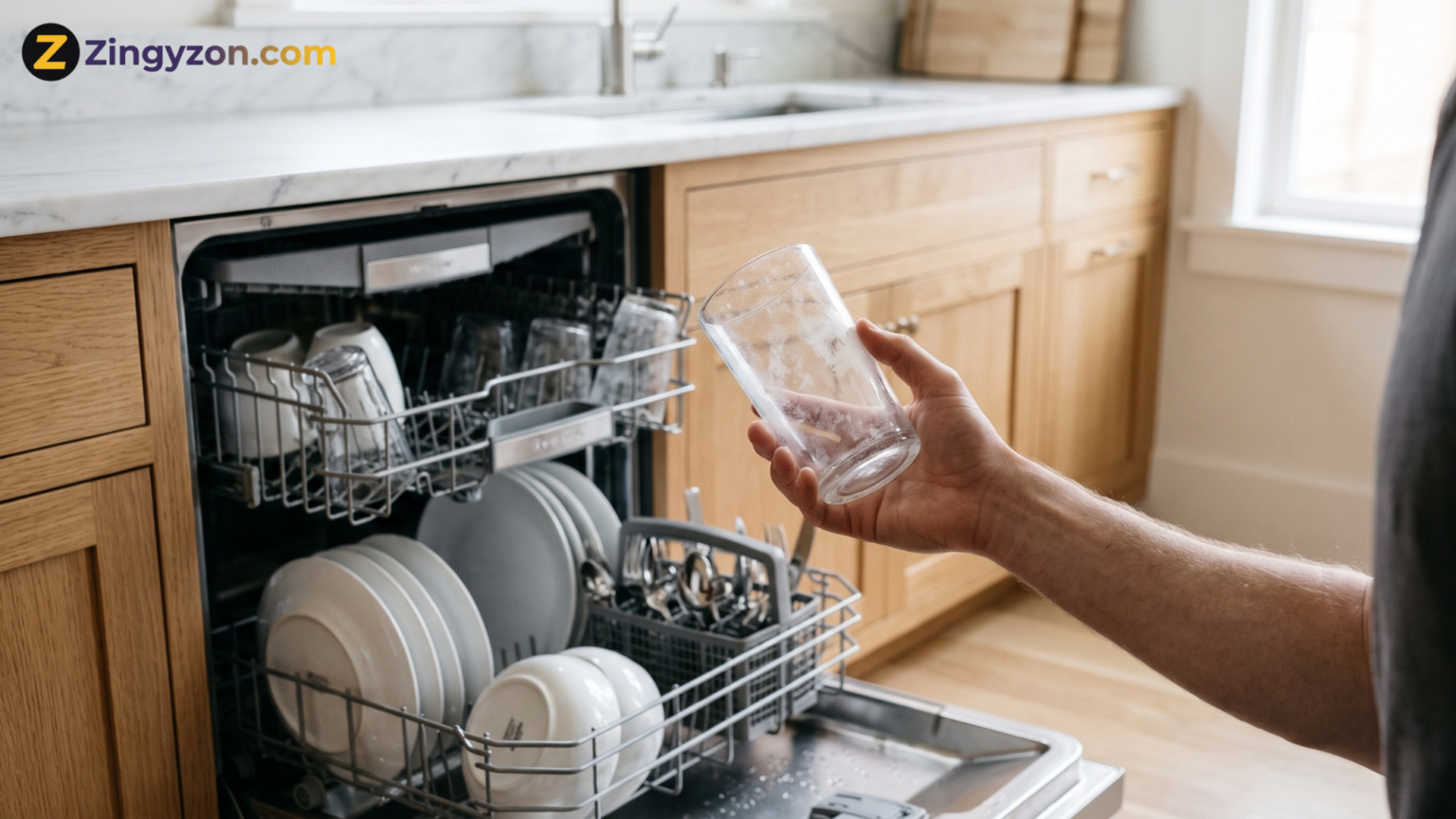
Opening your dishwasher after a cleaning cycle should reveal sparkling plates, spotless glasses, and clean silverware. However, finding cloudy glasses or a chalky white coating can be frustrating, especially when you expect your machine to handle the cleaning.
If your dishwasher leaving white residue on dishes has become a recurring problem, the most likely causes include hard water, excessive detergent, insufficient rinse aid, or poor water circulation. Fortunately, many of these issues can be resolved without expensive repairs.
White residue does not automatically mean your dishwasher is broken. In many cases, changing a setting, cleaning a component, or adjusting your detergent makes a noticeable difference.
At ZingyZon.com, we explore practical home appliance solutions that make everyday household maintenance easier. This guide explains why white deposits appear, how to remove them safely, and what you can do to prevent them from returning.
Why Is My Dishwasher Leaving White Residue on Dishes?
The most common reason is hard water. Water containing elevated levels of calcium and magnesium can leave mineral deposits on plates and glassware when droplets evaporate.
However, not every white mark comes from minerals. Undissolved detergent, poor rinsing, incorrect washing settings, and permanent glass damage can create similar appearances.
The best solution depends on identifying the type of residue.
For example, mineral deposits may dissolve when treated with white vinegar, while permanent glass etching will not disappear after cleaning.
Understanding this difference can save time and prevent unnecessary appliance repairs.
How to Identify Different Types of White Dishwasher Residue
Before making changes to your dishwasher, examine the affected dishes carefully.
Chalky White Spots
Small white circles or powdery patches commonly indicate mineral deposits. These marks frequently appear on drinking glasses, dark plates, and stainless steel utensils.
They are particularly common in households with hard water.
Cloudy White Film on Glasses
A cloudy film covering an entire glass may indicate mineral buildup, detergent residue, or glass etching.
If the cloudiness disappears after a short vinegar treatment, mineral deposits are likely responsible. If the surface remains permanently cloudy, glass etching may be the cause.
White Powder Inside the Dishwasher
Powdery material near the detergent dispenser or on dishes may indicate detergent that did not dissolve or rinse away properly.
Check whether the dispenser opens completely and whether water can circulate freely.
White Coating on Dishwasher Walls
A chalky coating on the dishwasher interior often suggests mineral accumulation.
When these deposits repeatedly return, testing the household water hardness is a sensible next step.
8 Common Causes of White Residue on Dishes After Dishwasher Cleaning
Several dishwasher problems can produce similar symptoms. Identifying the underlying cause helps you choose the right solution.
1. Hard Water Mineral Buildup
Hard water is one of the leading causes of white spots on dishes.
As water dries, dissolved calcium and magnesium minerals can remain on glass and ceramic surfaces. Repeated washing allows these deposits to accumulate.
Common signs include:
- White spots on drinking glasses
- Chalky deposits on dishwasher walls
- Cloudy plates after drying
- Limescale around faucets and showerheads
A household water hardness test can help confirm the problem.
If your water is particularly hard, you may need an appropriate water-softening solution or dishwasher maintenance product.
2. Insufficient Dishwasher Rinse Aid
Rinse aid helps water drain from dishes rather than forming droplets that leave visible spots.
Without enough rinse aid, water may remain on glassware until the drying cycle finishes.
This increases the chance of mineral spotting.
Many dishwashers include a rinse aid indicator or an adjustable dispenser.
Check the reservoir and refill it with a product specifically designed for automatic dishwashers. Adjust the dosage according to your appliance manual.
3. Using Too Much Dishwasher Detergent
Adding extra detergent does not necessarily improve cleaning performance.
Excessive detergent can contribute to unwanted residue, particularly when household water is relatively soft.
Powder detergent may also clump after exposure to moisture, preventing it from dissolving correctly.
Use the recommended detergent quantity and consider your water hardness when choosing a product.
If white powder appears on dishes, inspect the detergent dispenser before assuming the water supply is responsible.
4. Dirty Dishwasher Filter
A dishwasher filter captures food particles and other debris during washing.
When the filter becomes clogged, cleaning performance can suffer.
Food residue may circulate through the machine, while restricted water movement can interfere with effective rinsing.
Some dishwashers have manually cleaned filters, while others use different filtration systems.
Follow your manufacturer’s instructions to inspect and clean the filter safely.
Regular filter maintenance can help improve cleaning results and reduce unpleasant odors.
5. Overloading the Dishwasher
Packing too many dishes into the machine prevents water from reaching every surface.
Large plates may block spray arms, while tightly arranged bowls can trap dirty water.
Overloading also makes it harder for detergent to circulate and rinse away.
Leave sufficient space between dishes and position them according to the dishwasher’s loading instructions.
Before starting a cycle, confirm that the spray arms can rotate without hitting cookware or utensils.
6. Incorrect Wash Cycle or Water Temperature
Different dishwasher programs are designed for different cleaning requirements.
A quick wash may not provide the same cleaning performance as a normal or intensive cycle, particularly for heavily soiled dishes.
Water temperature also influences detergent dissolution and grease removal.
If the incoming water is too cool or the wash program is unsuitable, residue may remain.
Choose an appropriate cycle and follow the manufacturer’s recommended temperature requirements.
Avoid selecting unnecessarily high temperatures for delicate glassware.
7. Incorrect Water Softener Settings
Some dishwashers include built-in water-softening systems that require special dishwasher salt.
If the softener is incorrectly configured or the salt reservoir is empty, mineral deposits may appear.
This feature is not available on every dishwasher, particularly some models sold in the United States.
If your appliance includes a salt reservoir, check its instructions and water hardness setting.
Never replace dishwasher salt with ordinary table salt unless the manufacturer specifically permits it.
8. Permanent Glass Etching
Sometimes, cloudy glassware is not covered in removable residue.
Glass etching occurs when the glass surface becomes permanently damaged.
It may develop through a combination of unsuitable detergent concentration, water conditions, high temperatures, and repeated washing.
Unlike mineral deposits, etching cannot be removed through ordinary cleaning.
If vinegar does not clear the cloudy appearance, avoid repeatedly scrubbing the glass with abrasive products.
The better approach is preventing additional damage to unaffected glassware.
How to Remove White Residue From Dishes: Step-by-Step Fixes
Once you understand the possible causes, begin with simple maintenance tasks before considering professional repairs.
Step 1: Test Whether the Residue Is Removable
Start with one affected dishwasher-safe glass.
Apply a little white vinegar to a soft cloth or briefly soak the affected glass in a suitable diluted vinegar solution.
After approximately five minutes, rinse thoroughly and inspect the surface.
If the white film disappears, hard water deposits are a likely cause.
If cloudiness remains unchanged, permanent etching or another type of surface damage may be responsible.
Avoid vinegar on delicate decorative finishes, natural stone, or materials that are not acid-safe.
Step 2: Clean the Dishwasher Filter
Remove the lower rack to access the filter if your dishwasher has a removable filtration assembly.
Follow the appliance manual to unlock and remove it.
Rinse the filter under running water, using a soft brush to remove trapped food particles.
Check the accessible filter housing for debris, including sharp glass fragments.
Do not reach blindly into the sump or remove protected mechanical components.
Reinstall the filter securely before running another cycle.
Step 3: Inspect and Clean the Spray Arms
Spray arms distribute water throughout the dishwasher.
If their openings become blocked with mineral deposits or debris, washing performance can deteriorate.
Check whether the arms rotate freely and inspect accessible spray holes.
Remove and rinse the arms only if your appliance manual permits it.
Use a soft cleaning tool recommended by the manufacturer rather than forcing sharp metal objects into the openings.
Proper water circulation helps detergent reach dishes and rinse away effectively.
Step 4: Refill and Adjust the Rinse Aid
Locate the rinse aid dispenser, normally positioned near the detergent compartment.
Fill it with a dishwasher-compatible rinse aid according to the product and appliance instructions.
If your machine has an adjustable rinse aid setting, begin with the recommended level.
When spotting persists, adjust gradually rather than immediately selecting the highest setting.
Too much rinse aid can create its own streaking problems.
Run another wash cycle and compare the results before making additional changes.
Step 5: Review Your Dishwasher Detergent
Check whether you are using detergent designed specifically for automatic dishwashers.
Ordinary hand dishwashing liquid must never be substituted because it can create excessive foam.
If you use powder detergent, make sure it is fresh and stored in a dry location.
If tablets remain partly undissolved, examine the dispenser for obstructions and confirm that the selected cycle is suitable.
Trying a different quality dishwasher detergent may also help.
Remember that the correct detergent amount depends on the product, water conditions, and dishwasher instructions.
Step 6: Descale the Dishwasher Safely
If mineral deposits cover the dishwasher interior, descaling may improve its performance.
Choose a dishwasher descaling product approved for your model.
Follow the cleaner’s instructions regarding dosage, cycle selection, and whether the machine must be empty.
Avoid improvising with strong acids, bleach, or combinations of household cleaning chemicals.
Some manufacturers permit limited vinegar cleaning procedures, while others discourage vinegar because repeated acidic exposure can damage components.
Never mix vinegar with bleach or other cleaners.
A manufacturer-approved descaler is generally the safer starting point.
Step 7: Run a Test Wash
After completing basic maintenance, load a small selection of ordinary dishwasher-safe dishes.
Avoid overcrowding and choose the normal wash cycle recommended for your appliance.
Use the correct detergent amount and confirm the rinse aid reservoir is filled.
When the cycle finishes, examine the glasses and plates under good lighting.
If the residue disappears, your adjustments have likely addressed the problem.
If it remains, investigate water hardness, washing performance, or possible mechanical faults.
How to Prevent White Residue in Your Dishwasher
Preventing future white deposits is often easier than repeatedly cleaning affected dishes.
A consistent maintenance routine can help your dishwasher perform more reliably.
Test Your Household Water Hardness
Water hardness varies between locations and sometimes between different water supplies within the same region.
A simple hardness test strip provides useful information.
If your water is very hard, evaluate whether an appropriate water softener or manufacturer-approved detergent additive would help.
Use your dishwasher’s water hardness adjustment if the model includes one.
Load Dishes Correctly
Place plates with their dirty surfaces facing the spray area.
Keep bowls angled so water can drain, and avoid nesting utensils tightly together.
Position lightweight dishwasher-safe plastics according to the manufacturer’s instructions.
Proper spacing helps improve both cleaning and drying.
Maintain a Regular Cleaning Schedule
Inspect the filter frequently, especially when your household runs several dishwasher cycles each week.
Check the spray arms periodically and remove visible deposits using approved methods.
Use a dishwasher cleaning or descaling product when necessary, following the manufacturer’s recommended maintenance interval.
Choose Appropriate Wash Programs
A normal or automatic cycle is usually suitable for everyday mixed loads.
Use intensive cleaning settings only when appropriate for the dishes and soil level.
For households exploring connected appliances, our guide to smart appliances worth buying for modern homes explains how some modern dishwashers provide maintenance reminders, cycle notifications, and additional convenience features.
Common Dishwasher Cleaning Mistakes to Avoid
Even well-intentioned cleaning habits can make white residue problems worse.
One common mistake is adding additional detergent whenever dishes look cloudy. If the problem is excessive detergent or glass etching, this may make matters worse.
Another is repeatedly washing the same cloudy glass without determining whether the marks are removable.
Avoid these habits:
- Using handwashing soap inside an automatic dishwasher
- Overfilling detergent compartments
- Ignoring rinse aid warning indicators
- Blocking spray arms with oversized cookware
- Using abrasive materials on delicate glassware
- Mixing household cleaning chemicals
- Ignoring manufacturer-specific maintenance instructions
Improving dishwasher performance usually requires a combination of correct detergent use, suitable water conditions, and consistent maintenance rather than one aggressive cleaning treatment.
When Should You Call a Dishwasher Repair Technician?
Most white residue problems can be investigated through ordinary maintenance. However, professional assistance may be necessary when cleaning and settings adjustments do not help.
Consider arranging service if you notice:
- Detergent repeatedly remaining undissolved
- Spray arms failing to operate correctly
- Water remaining inside the machine after a cycle
- Persistent filling or draining problems
- Unusual mechanical noises
- Error codes or repeated interrupted cycles
- Poor cleaning performance across multiple wash programs
These symptoms may involve circulation pumps, heating components, water inlet systems, sensors, or drainage equipment.
Do not attempt internal electrical or mechanical repairs without suitable qualifications.
If an older dishwasher requires expensive repairs, compare the estimate with the cost and expected benefits of a replacement.
Our article on the best kitchen appliances for modern homes provides additional guidance on choosing practical appliances for everyday kitchen use.
Frequently Asked Questions
1. Why is my dishwasher leaving white powder on dishes?
White powder may come from undissolved dishwasher detergent, mineral deposits, or poor rinsing. Check the detergent dispenser, water hardness, filter, and spray arms to identify the cause.
2. How do I remove white film from dishwasher glasses?
If the film is caused by hard water minerals, a brief treatment with white vinegar may help remove it from acid-safe glassware. Rinse thoroughly afterward. Permanent glass etching cannot be cleaned away.
3. Can too much dishwasher detergent cause white residue?
Yes. Excessive detergent may contribute to visible residue, particularly when water is soft or the dishwasher does not rinse effectively. Use the detergent amount recommended for your water conditions and appliance.
4. Does rinse aid prevent white spots on dishes?
Rinse aid reduces water spotting by helping water drain from surfaces during the final rinse. It can improve drying and reduce visible mineral marks, although it does not eliminate the minerals in hard water.
5. Is white residue from the dishwasher harmful?
Many white deposits are ordinary hard water minerals, but their appearance alone cannot confirm what they contain. If dishes have a chemical smell, unusual taste, or visible detergent residue, rinse them thoroughly and investigate the cause before use.
6. How often should I clean my dishwasher to prevent white residue?
Check the filter regularly and follow your manufacturer’s maintenance schedule. Households with hard water or frequent dishwasher use may need more frequent descaling and cleaning to prevent mineral buildup.
Conclusion
A dishwasher leaving white residue on dishes is often experiencing a manageable problem rather than a major mechanical failure. Hard water, incorrect detergent quantities, insufficient rinse aid, and restricted water circulation are common causes worth investigating first.
Start by identifying whether the deposits are removable, then clean accessible components, review dishwasher settings, and address water hardness when necessary. Consistent maintenance and correct loading habits can help prevent the issue from returning.
With the right troubleshooting approach, you can improve your dishwasher’s cleaning performance, protect your glassware, and enjoy cleaner dishes without unnecessary repair expenses.


Keep Exploring Zingyzon.com
Read more Zingyzon SEO, digital marketing, online earning, business, and technology guides for Australia, USA, and global readers.