
How to Revive Compacted Garden Soil
Healthy soil contains pore spaces that allow air, water, roots, and soil organisms to move. When pressure squeezes soil particles […]
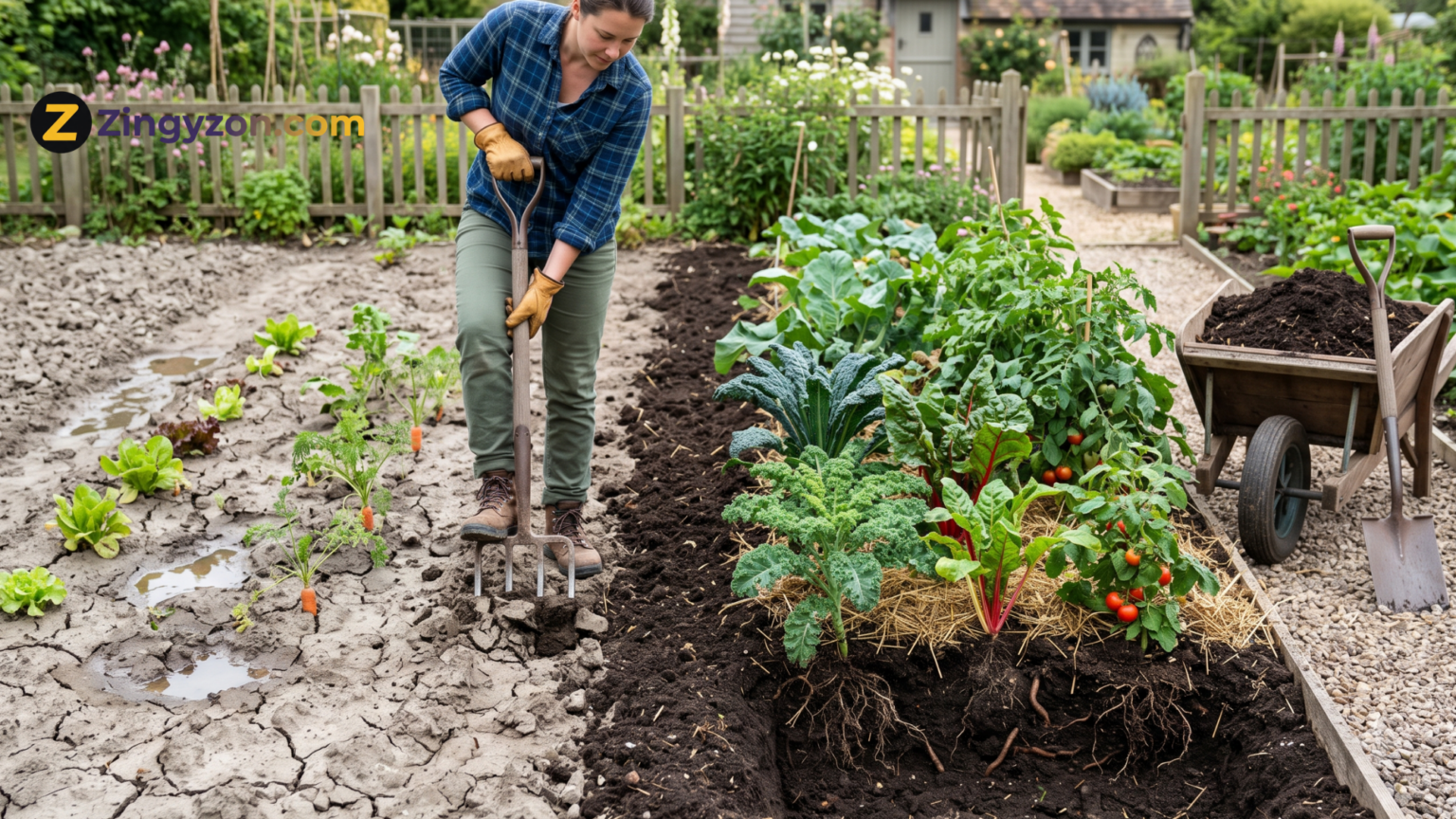
Healthy soil contains pore spaces that allow air, water, roots, and soil organisms to move. When pressure squeezes soil particles together, those spaces shrink. Water may collect on the surface, roots may remain shallow, and plants can struggle even when they receive enough fertilizer.
Learning how to revive compacted garden soil is not about making the surface look fluffy for a few days. The goal is to rebuild stable soil structure so water can enter, excess moisture can drain, roots can spread, and beneficial organisms can remain active.
Most beds improve through a combination of careful loosening, mature compost, organic mulch, living roots, and better traffic control. The correct treatment depends on whether the compaction is shallow, deep, localized, or connected to a larger drainage problem.
What Is Compacted Garden Soil?
Compaction occurs when soil particles are pressed together and pore space is reduced. Large pores are especially important because they move water and oxygen through the root zone. Compacted soil has fewer of these pathways, so infiltration, drainage, gas exchange, and root growth may decline.
Clay soil and compacted soil are not the same thing. Clay naturally contains very small mineral particles and may feel sticky when wet or hard when dry. However, clay can still have a healthy structure when its particles form stable aggregates. Compaction is damage caused by pressure, and sandy or loamy soil can also become compacted.
Surface compaction may result from footsteps, heavy rain, or overhead irrigation. A deeper dense layer can develop after construction traffic, vehicles, repeated tilling at the same depth, or years of working wet ground.
Signs Your Garden Soil Is Compacted
Compaction usually produces several related symptoms:
- Water pools or runs off instead of soaking in.
- The surface forms a hard crust or large cracks.
- A trowel, fork, or screwdriver is difficult to insert.
- Plant roots remain shallow, bent, or spread sideways.
- Seeds establish poorly and plants grow slowly.
- Soil breaks into dense slabs rather than loose crumbs.
- Bare areas repeatedly appear along walking or equipment routes.
Do not assume every wet area is compacted. Poor grading, a high water table, buried rubble, an impermeable subsoil layer, leaking irrigation, or excessive watering may create similar symptoms.
Test the Soil Before Treating It
Inspect the garden after ordinary rainfall or irrigation. Mark areas where water stands longer than elsewhere and note whether they correspond with paths, former construction zones, or frequently worked beds.
Push a long screwdriver, metal rod, or garden fork into moist—not saturated—soil. Sudden resistance at a similar depth in several places may reveal a compacted layer. Completely dry ground naturally resists tools, so moisten it first and test again.
Dig a small inspection hole about 8 to 12 inches deep. Look for roots turning sideways, smooth or smeared layers, buried debris, few worm channels, and soil that appears massive rather than crumbly.
A simple infiltration test is also useful. Press an open-ended can a few inches into the soil, add a measured amount of water, and record how long it takes to disappear. Compare several locations because one test cannot represent an entire garden.
Consider a laboratory soil test before adding lime, gypsum, fertilizer, or large amounts of compost. A standard test may not measure every physical restriction, but it can reveal pH, salinity, organic-matter, and nutrient issues that affect your restoration plan.
Remove the Cause First
Foot traffic is a major source of garden compaction, especially when the ground is wet. Water allows particles to slide closer together, so walking, digging, or using a wheelbarrow after rain can undo previous improvements.
Create permanent paths and keep growing beds narrow enough to reach from the sides. Redirect pets and regular walking routes, and avoid parking equipment on planting areas.
Protect beds from construction activity. If work must cross the garden, clearly mark no-traffic zones and use temporary load-distributing boards only where access is unavoidable.
Wait for Safe Working Conditions
Never loosen saturated soil. Digging wet clay can smear its surfaces, destroy aggregates, and leave hard clods when it dries.
Squeeze a handful before working. If water appears or the soil forms a shiny, sticky ribbon, wait. If it holds briefly but crumbles under moderate pressure, conditions are usually safer.
Extremely dry soil can also be difficult to loosen. Water it gently, allow moisture to move downward, and return after a day or two. Utah State University Extension also recommends avoiding tilling and traffic when clay soil is wet because it is especially vulnerable to compaction.
Loosen the Soil With a Fork or Broadfork
For a small or moderately compacted bed, insert a garden fork vertically and rock the handle backward. The aim is to lift and crack the soil slightly, not turn every layer upside down. Move a few inches and repeat across the bed.
A broadfork performs the same basic task across a wider area. Press its long tines into the ground, pull the handles back, and work backward so you do not stand on the loosened section.
Gentle loosening preserves more roots, worms, and soil layers than aggressive digging. Stop if you encounter major tree roots, irrigation lines, cables, or unknown underground services.
If tools repeatedly stop at the same depth, investigate the restriction. Buried construction debris or a deep hardpan may need professional equipment or partial soil replacement. Simply cultivating the upper few inches will not correct a deeper barrier.
Garden forks and broadforks generally disturb soil less than rototillers, while repeated or excessive cultivation can weaken soil structure.
Add Mature Compost
After gently opening an empty bed, spread about 1 to 2 inches of mature compost across the surface. In a new annual bed, it can be mixed lightly into the upper several inches when soil moisture is suitable.
Compost helps soil particles form aggregates and supports organisms involved in building structure. It can improve water and air movement in fine-textured soil while helping sandy soil hold moisture and nutrients. Organic matter is widely recommended for improving garden-soil structure, aeration, drainage, and water management.
More is not always better. Compost can contain significant nutrients and salts, so repeated heavy applications may create imbalances. Use finished material that smells earthy and no longer heats strongly.
Do not bury fresh manure, unfinished kitchen scraps, or large quantities of raw wood in the root zone. These materials can temporarily affect nutrient availability, introduce pathogens, or create uneven decomposition.
For suitable amendment choices, read this guide to the best ingredients for garden soil.
Improve Established Beds From the Surface
Deep digging is risky in beds containing perennials, shrubs, or established vegetables because it can sever roots.
Instead, top-dress with a thin layer of mature compost and cover it with mulch. Earthworms, microorganisms, roots, and water movement will gradually carry organic material into the upper soil.
Use a hand fork only in open spaces where major roots are absent. Around mature trees, avoid aggressive cultivation beneath the canopy. Consult a qualified arborist when construction traffic has severely compacted the root zone of an important tree.
Protect Soil With Organic Mulch
Bare soil receives the full impact of rain, sprinklers, temperature changes, and accidental footsteps. Organic mulch cushions the surface and creates more stable conditions for soil organisms.
Apply roughly 2 to 4 inches of shredded leaves, clean straw, arborist wood chips, or another suitable material. Keep it away from plant stems and tree trunks to prevent constant moisture against the tissue.
Use finer mulch around annual crops and coarser wood chips on paths or around woody plants. Mulched paths also show people where to walk and spread pressure more evenly.
Replenish the layer as it decomposes. Year-round surface protection is one of the simplest ways to stop revived soil from becoming compacted again. Mulch can reduce the compacting effects of rainfall and traffic while supporting earthworms and other soil organisms.
Use Cover Crops and Living Roots
Living roots create channels, feed microorganisms, and leave organic material behind when they die. In empty vegetable beds, a suitable cover crop can improve structure while protecting the surface from erosion.
Choose a cover crop suited to your climate and planting schedule, and terminate it before seed formation unless self-seeding is intentional. Vigorous grasses may become difficult to remove if allowed to mature.
Deep-rooted plants can gradually explore cracks in hard soil, but they will not instantly repair severe construction compaction. Combine them with compost, mulch, and controlled traffic.
Cover crops can add organic matter, protect empty beds, support soil organisms, and improve soil structure and compaction over time.
Revive a Compacted Lawn With Core Aeration
Garden-bed methods are not always suitable for turf. For a compacted lawn, use a core aerator that removes small plugs of soil.
Core aeration is generally more effective than solid spike tools. Spikes create holes by pushing soil sideways, which can increase pressure around each opening. Removed cores create actual space.
Aerate while the grass is actively growing and the soil is moist enough to produce full plugs but not wet enough to smear. Several passes may be needed in heavily used areas.
Leave the cores to break down naturally. A light compost topdressing can then enter the openings. Mark shallow irrigation pipes, cables, and other underground features before operating equipment.
Correct Drainage Problems Separately
Loosening compacted soil can improve infiltration, but it cannot solve every water problem.
Observe where the water originates. Downspouts, neighboring slopes, leaking irrigation, low spots, and hard surfaces may direct more runoff into a bed than it can absorb.
Correct grading or water-routing problems before repeatedly adding amendments. A rain garden, swale, drain, or moisture-tolerant planting scheme may be more suitable in naturally wet locations.
A raised bed can create a productive root zone above severe compaction, contamination, or unsuitable subsoil. However, water must still be able to move away from the area around and beneath the bed. Organic matter cannot correct ponding when water has nowhere lower to drain.
Do Not Automatically Add Sand
Mixing a small amount of sand into clay rarely creates loose loam. Fine clay particles can fill the spaces between sand grains and produce a dense mixture.
Meaningfully changing soil texture requires a very large and carefully calculated volume of mineral material. In most home gardens, building stable structure with organic matter and roots is safer and more practical.
Sand belongs in professionally designed soil blends and specific construction applications, not as a universal treatment for hard ground. Utah State University Extension warns that incorrect proportions of sand and clay can produce an extremely compact, concrete-like material.
Use Gypsum Only for the Right Soil
Gypsum may improve certain sodium-affected soils because its calcium can replace sodium on soil particles. It is not a reliable cure for every clay or compacted garden.
Apply it only when a soil analysis and local expert guidance show that it is needed. Unnecessary gypsum may alter soil chemistry without removing the pressure or drainage issue that caused the problem.
Be equally cautious with products advertised as liquid aerators. They cannot remove buried rubble or physically fracture a deep compacted layer, and claims of instant permanent loosening should be treated carefully. Soil response to gypsum varies, and soil scientists do not agree that it reliably improves all clay-rich soils.
Common Restoration Mistakes
Avoid working wet ground, stepping on newly loosened beds, applying fertilizer without evidence of a deficiency, and repeatedly tilling at one depth.
Do not expect unfinished organic waste to behave like compost. Produce mature material separately before applying it to planting beds. This guide to balcony composting without smell explains how to manage moisture, airflow, and food scraps in a small composting system.
Do not expect complete recovery in one weekend. Soil structure develops through repeated interactions among roots, organisms, organic materials, moisture, and minerals.
Step-by-Step Compacted Soil Recovery Plan
- Stop walking or moving equipment across the growing area.
- Test several locations and identify the depth of resistance.
- Rule out runoff, buried debris, and other drainage causes.
- Wait until the soil is moist but crumbly.
- Loosen an empty bed gently with a fork or broadfork.
- Add 1 to 2 inches of mature compost.
- Cover the soil with appropriate organic mulch.
- Grow vegetables, flowers, or a suitable cover crop.
- Maintain permanent paths and avoid working wet soil.
- Recheck infiltration, root depth, and structure each season.
How Long Does Recovery Take?
Light surface compaction may improve during one growing season after traffic stops and the soil receives compost, mulch, and active roots.
Moderate compaction may take several seasons of consistent care. Deep construction compaction can remain for years unless the dense layer is physically fractured, excavated, or bypassed with a raised growing system.
Measure progress by function rather than appearance. Look for faster water infiltration, deeper roots, easier tool penetration, increased worm channels, healthier plants, and soil that breaks into stable crumbs.
Explore more practical gardening and home-improvement guides on Zingyzon.com.
Frequently Asked Questions
What is the fastest way to loosen compacted garden soil?
For a small empty bed, wait until the soil is moist but not wet, loosen it with a garden fork or broadfork, add mature compost, and protect the surface with mulch.
Can compacted soil be fixed without digging?
Yes. For mild compaction or established beds, top-dress with compost, apply organic mulch, grow deep-rooted plants, and stop foot traffic. Improvement is slower but less disruptive.
How much compost should I add?
About 1 to 2 inches is suitable for many home-garden beds. The ideal amount depends on compost quality, previous applications, soil-test results, and the crops being grown.
Should I rototill hard garden soil?
Occasional tillage may help establish a new bed, but frequent tilling can damage aggregates and form a compacted layer beneath the worked soil. A fork or broadfork offers more controlled loosening.
Does gypsum break up compacted soil?
Gypsum is useful mainly for specific sodium-related soil problems. It does not automatically improve all clay or compacted soil, so test before applying it.
Can I add sand to loosen clay?
A small amount of sand may make clay denser. Home gardeners usually get better results by adding mature organic matter, protecting the surface, and using living roots.
Why does water sit on top of my soil?
Compaction or crusting may slow infiltration, but low grading, overwatering, buried layers, and a high water table can cause the same symptom. Identify the source before treating it.
Are earthworms enough to repair compaction?
Earthworms create useful channels, but severe compaction can restrict their activity. Support them with organic matter and mulch while physically loosening serious restrictions where appropriate.
How do I prevent the soil from compacting again?
Use permanent paths, avoid working wet ground, keep beds covered with mulch or plants, add reasonable amounts of organic matter, and minimize unnecessary tillage.
Is a raised bed the best solution?
A raised bed can bypass very poor soil and provide a controlled root zone. It is helpful for severe compaction, but safe soil selection and underlying drainage still matter.
Final Thoughts
Knowing how to revive compacted garden soil begins with diagnosis rather than a quick-fix product. Find the dense layer, identify its cause, and rule out larger drainage problems.
For most beds, the strongest plan combines gentle mechanical loosening with mature compost, organic mulch, living roots, and permanent traffic-free growing areas.
Avoid working saturated soil or adding sand, fertilizer, gypsum, and liquid treatments without a specific reason. These choices may waste money or create new problems.
Recovery is gradual, but every season of protected surfaces, active roots, and careful management builds a more resilient garden. The result is better water movement, stronger roots, healthier plants, and soil that becomes easier to maintain.
Keep Exploring Zingyzon.com
Read more Zingyzon SEO, digital marketing, online earning, business, and technology guides for Australia, USA, and global readers.