
The Complexity of Peptide Process Development and the Experts Behind the Drug
Peptide medicines occupy a fascinating space between traditional small-molecule drugs and large biological products. They are built from amino acids—the […]
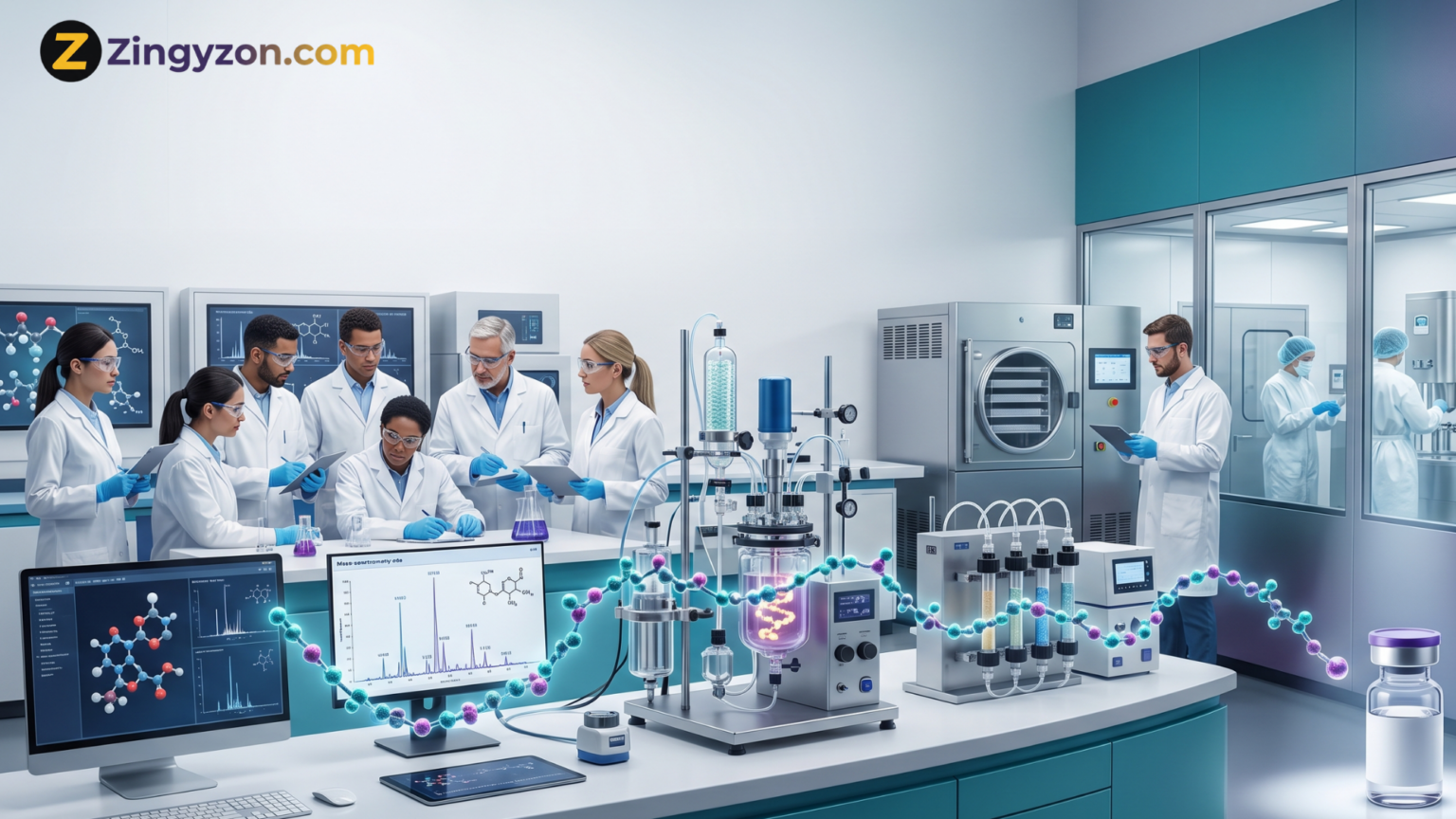
Peptide medicines occupy a fascinating space between traditional small-molecule drugs and large biological products. They are built from amino acids—the same basic components found in proteins—but producing them as consistent, safe, and scalable medicines requires far more than simply joining those amino acids in the correct order.
A peptide that performs well during early laboratory research may behave very differently when scientists attempt to manufacture hundreds of grams or several kilograms. Reactions may become less efficient, impurities may accumulate, purification may consume large volumes of solvent, and the final molecule may become unstable during storage or formulation.
That is why peptide process development is not a single laboratory activity. It is a coordinated scientific and engineering programme that converts a promising molecular sequence into a reproducible manufacturing process.
Medicinal chemists, process chemists, analytical scientists, formulation specialists, engineers, quality professionals, regulatory experts, and manufacturing teams all contribute to this transformation. Their work determines whether a peptide remains an interesting laboratory discovery or becomes a practical drug candidate that can be evaluated and, potentially, supplied to patients.
What Is Peptide Process Development?
Peptide process development is the systematic design, optimisation, scale-up, and control of the manufacturing process used to produce a peptide drug substance or active pharmaceutical ingredient.
The work usually begins after researchers have identified a promising peptide sequence. Early discovery teams may have produced only milligram quantities, often using methods selected for speed rather than cost, efficiency, or large-scale reproducibility.
Process developers must then answer several important questions:
- Which synthesis route is most suitable?
- Can the peptide be manufactured consistently at a larger scale?
- Which impurities form during each step?
- How can those impurities be controlled or removed?
- Which raw materials and solvents are acceptable?
- How should the peptide be purified, isolated, and stored?
- Which analytical tests are needed to confirm quality?
- Can the process meet regulatory and commercial requirements?
The ultimate goal is not simply to produce the peptide once. It is to establish a process that repeatedly produces material with the intended identity, purity, potency, and physical characteristics.
Why Peptides Are Difficult to Manufacture
A peptide may contain only a few amino acids or several dozen. However, every additional amino acid introduces another chemical coupling step and another opportunity for something to go wrong.
During synthesis, an amino acid may fail to attach completely. A protecting group may not be removed as intended. The growing peptide chain may fold, aggregate, or become less accessible to reagents. Certain amino acids may undergo oxidation, rearrangement, or epimerisation.
Small inefficiencies become increasingly important as the sequence grows. Suppose each coupling step performs extremely well but not perfectly. After many repeated reactions, the cumulative amount of correctly assembled full-length peptide may decline considerably.
The crude product may contain a complicated mixture of:
- Full-length target peptide
- Shortened or truncated sequences
- Deletion impurities
- Insertion impurities
- Incorrectly modified sequences
- Oxidised products
- Epimerised amino acids
- Residual protecting-group derivatives
- Process-related contaminants
Many of these impurities closely resemble the desired molecule. Their similar size, charge, and hydrophobicity make separation difficult. Some may also have biological activity or immunogenic potential, which makes their control particularly important.
Turning a Discovery Sequence Into a Manufacturable Molecule
The molecule selected during drug discovery is usually designed primarily for biological activity. Researchers may focus on receptor binding, potency, selectivity, or duration of action.
Manufacturing behaviour may receive less attention during these early experiments. Once development progresses, the team may discover that the sequence has poor solubility, strong aggregation tendencies, unstable amino acids, or difficult purification characteristics.
Developability assessments help identify these risks before the programme reaches an expensive manufacturing stage. Scientists examine the peptide’s sequence, charge distribution, hydrophobic regions, chemical modifications, and likely degradation pathways.
Minor structural changes may sometimes improve manufacturability without eliminating biological activity. Possible changes include replacing an unstable amino acid, adjusting the location of a modification, altering a linker, or selecting a different terminal group.
These decisions require close collaboration between discovery scientists, process developers, analytical specialists, toxicologists, and clinical teams. Changing the molecule too late can affect preclinical data, regulatory documentation, intellectual property, and development timelines.
Choosing the Right Synthesis Strategy
The first major manufacturing decision is selecting how the peptide will be produced. The most common options include solid-phase peptide synthesis, liquid-phase synthesis, hybrid strategies, and biological or recombinant production.
Solid-Phase Peptide Synthesis
Solid-phase peptide synthesis, commonly called SPPS, is widely used for synthetic therapeutic peptides. The first protected amino acid is attached to an insoluble resin. Additional amino acids are then added one at a time through repeated deprotection, washing, activation, and coupling cycles.
SPPS offers several advantages. Excess reagents can drive reactions toward completion, while soluble by-products can be removed through washing. The method is also compatible with automated equipment and a wide range of non-natural amino acids or chemical modifications.
Its limitations become more apparent at scale. SPPS can consume substantial quantities of amino acids, coupling reagents, solvents, and resin. Long sequences may aggregate on the solid support, causing incomplete reactions. Large-scale mixing, heat transfer, solvent handling, filtration, and waste management also become significant engineering concerns.
Liquid-Phase Peptide Synthesis
Liquid-phase peptide synthesis builds peptides or peptide fragments in solution. Intermediates may be isolated and purified between reactions, giving scientists more direct control over individual stages.
This method can be efficient for shorter peptides or sequences with repeatable fragments. However, isolation and purification after multiple steps may lengthen the process and reduce overall yield.
Hybrid and Fragment-Based Synthesis
A hybrid approach may combine solid-phase and liquid-phase methods. Separate peptide fragments can be prepared and then joined through fragment condensation or ligation.
This strategy can reduce the difficulty of assembling a long sequence one amino acid at a time. It also creates new challenges, including fragment solubility, coupling efficiency, racemisation risk, and the purification of closely related intermediates.
Recombinant Production
Some longer peptides are produced through engineered microorganisms or cell-based systems. Recombinant manufacture may be attractive when chemical synthesis becomes inefficient or when the molecule resembles a small protein.
Biological production introduces a different set of concerns. These include expression levels, cell-culture control, host-cell impurities, proteolytic degradation, recovery, folding, and downstream purification.
The most suitable route depends on sequence length, structural complexity, modifications, scale, cost, purity requirements, and available manufacturing technology.
Optimising Amino Acid Coupling
Each coupling reaction must attach the correct amino acid efficiently while limiting unwanted reactions. Process chemists study reagent ratios, reaction time, temperature, solvent composition, mixing, and the choice of activation chemistry.
A condition that works in a small vessel may perform differently in a large reactor. Mixing becomes less uniform, heat may disperse differently, and the resin may swell or settle unevenly.
Difficult sequence regions often require targeted optimisation rather than simply repeating a standard cycle. Scientists may use double coupling, longer reaction times, different solvents, altered protecting groups, or specialised amino-acid derivatives.
However, adding more reagent or extending every reaction is not automatically a good solution. It can increase cost, waste, impurity formation, and environmental burden. The process must balance completeness with efficiency and scalability.
Managing Protecting Groups and Side Reactions
Amino acids contain several reactive chemical groups. Temporary protecting groups prevent unwanted reactions while the peptide chain is being assembled.
The protection strategy must remain stable during some steps but be removable under carefully selected conditions during others. Poor protecting-group control may lead to branched products, incomplete deprotection, structural damage, or difficult-to-remove impurities.
Certain sequences are especially vulnerable to side reactions. Aspartic acid may form aspartimide-related products, methionine and tryptophan may oxidise, cysteine may form unintended disulfide bonds, and some amino acids may undergo epimerisation.
Process developers investigate where these reactions occur and how strongly they respond to time, temperature, pH, oxygen, light, or reagent exposure. The resulting knowledge helps establish critical process parameters and suitable in-process controls.
Cleavage and Global Deprotection
After solid-phase assembly is complete, the peptide must be released from the resin. Remaining side-chain protecting groups are usually removed during the same general stage.
This cleavage step often involves strong acids and carefully selected scavengers. The conditions must remove protecting groups efficiently without damaging sensitive parts of the peptide.
Cleavage chemistry can generate heat, vapours, corrosive mixtures, and reactive by-products. Scaling the reaction therefore requires process-safety studies, compatible equipment, controlled addition rates, ventilation, and safe waste handling.
The crude peptide may then be separated from the resin and precipitated or otherwise recovered. Conditions used during this stage can influence yield, impurity carryover, filtration behaviour, and the physical properties of the crude material.
Purification: Frequently the Main Bottleneck
Producing the crude peptide is only part of the challenge. Purification is often one of the most technically demanding and expensive stages.
Preparative high-performance liquid chromatography is commonly used because it can separate the target peptide from closely related impurities. Yet chromatography becomes more difficult as scale increases.
Developers must optimise:
- Stationary-phase chemistry
- Column dimensions
- Mobile-phase composition
- Gradient conditions
- Flow rate
- Loading capacity
- Fraction collection criteria
- Temperature and pressure
- Solvent recovery
A method that produces excellent purity at a small analytical scale may become too slow, diluted, or expensive in production. Preparative methods must deliver acceptable resolution while maintaining throughput and controlling solvent consumption.
Scientists also need to understand where each impurity appears in the chromatographic profile. Fractions containing the desired peptide may require pooling decisions that balance recovery against purity.
Additional techniques—including precipitation, extraction, membrane processing, ion exchange, crystallisation, or multiple chromatography stages—may be integrated into the purification strategy.
The Critical Role of Analytical Development
A process cannot be controlled unless the product and its impurities can be measured accurately. Analytical development therefore begins early and continues throughout the product lifecycle.
Common analytical techniques include:
- High-performance liquid chromatography
- Ultra-performance liquid chromatography
- Liquid chromatography–mass spectrometry
- Amino-acid analysis
- Peptide mapping
- Water-content testing
- Residual-solvent analysis
- Counterion determination
- Elemental impurity testing
- Biological potency assays
- Microbiological testing where appropriate
No single test provides a complete quality picture. A peptide may show a strong purity result in one chromatographic method while another technique reveals a co-eluting impurity or structural variant.
Analytical scientists must establish that methods are specific, sensitive, accurate, precise, and suitable for their intended purpose. As development advances, important methods are validated for regulatory and routine quality-control use.
Reference standards, impurity standards, system-suitability requirements, and data-integrity controls also become essential.
Understanding Critical Quality Attributes
Critical quality attributes are physical, chemical, biological, or microbiological properties that must remain within appropriate limits to ensure product quality.
For a peptide drug substance, relevant attributes may include:
- Molecular identity
- Peptide content
- Purity and impurity profile
- Potency
- Stereochemical integrity
- Counterion level
- Residual solvents
- Water content
- Aggregation
- Particle characteristics
- Microbial quality
Not every measurable property is automatically critical. Scientists use product knowledge, risk assessment, experimental data, and regulatory expectations to determine which attributes could affect safety, effectiveness, stability, or manufacturing performance.
Once these attributes are understood, the team identifies material properties and process parameters that influence them.
From Process Parameters to a Control Strategy
A robust process does not depend only on testing the final batch. Quality must be designed and controlled throughout manufacturing.
A control strategy may include:
- Specifications for amino acids, resins, solvents, and reagents
- Defined reaction temperatures and times
- In-process tests for coupling or deprotection completion
- Limits on hold times
- Purification pooling criteria
- Controls for oxidation, moisture, and light
- Intermediate specifications
- Release testing for the final drug substance
Quality-by-design principles encourage teams to understand why a process works instead of relying solely on a fixed recipe. Design-of-experiments studies may evaluate several variables together and reveal interactions that one-factor-at-a-time experiments can miss.
This understanding becomes particularly valuable during scale-up, technology transfer, deviations, process changes, and commercial lifecycle management.
Isolation, Lyophilisation, and Physical Form
After purification, the peptide is often present in a dilute aqueous solution. It must be concentrated and converted into a stable form suitable for storage and further formulation.
Lyophilisation, or freeze-drying, is frequently used. The solution is frozen, and water is removed under reduced pressure through sublimation and secondary drying.
Cycle conditions affect drying time, residual moisture, appearance, stability, and manufacturing capacity. A laboratory cycle may not transfer directly to a large production dryer because freezing behaviour and heat transfer vary across equipment and container locations.
The final peptide may also be isolated with a particular counterion, such as acetate or another pharmaceutically appropriate form. Counterion content can influence solubility, pH, stability, and analytical results.
Formulation and Drug-Product Development
A purified peptide API is not yet a finished medicine. Formulation scientists must create a dosage form that protects the molecule and delivers it appropriately.
Many peptides are administered by injection because digestive enzymes and poor intestinal absorption limit oral delivery. Formulation challenges may include aggregation, oxidation, deamidation, adsorption to surfaces, and loss of biological activity.
Developers evaluate pH, buffer type, ionic strength, antioxidants, surfactants, preservatives, tonicity agents, and container-closure compatibility.
They must also determine whether the product should be supplied as a liquid, a freeze-dried powder, a prefilled syringe, or another presentation. Stability studies examine how the product responds to time, temperature, light, agitation, freezing, and transportation.
Drug-substance and drug-product teams must communicate closely because a process change in the API may alter formulation performance.
Scale-Up Is More Than Making a Larger Batch
Increasing the batch size changes the physical environment of the process. Mixing times, heat transfer, filtration rates, mass transfer, resin behaviour, precipitation, and column loading may all change.
Equipment geometry also matters. A process developed in one type of reactor or chromatography system may not behave identically at another facility.
Scale-up studies identify which operations are truly scale-dependent and which parameters should remain constant. Engineers and chemists use development data to define appropriate scaling relationships.
Pilot batches, engineering runs, and process-performance qualification eventually demonstrate whether the proposed commercial process can operate reliably.
Technology Transfer and GMP Manufacturing
Technology transfer moves the process from the development laboratory to a clinical or commercial manufacturing site. Successful transfer requires much more than sending a written procedure.
The receiving team needs the scientific reasoning behind each operation, including known failure modes, impurity behaviour, sampling methods, equipment requirements, and acceptable operating ranges.
Batch records, analytical procedures, specifications, risk assessments, safety information, and development reports must be accurate and complete.
Good Manufacturing Practice adds formal controls for documentation, training, equipment qualification, deviation management, change control, material traceability, and data integrity.
Organisations may work internally or partner with peptide process development experts that provide specialist synthesis, analytical, scale-up, and GMP manufacturing capabilities.
Selecting a partner should involve careful assessment of technical experience, quality history, equipment fit, regulatory readiness, supply-chain resilience, communication, and capacity.
The Experts Behind a Peptide Drug
Peptide development depends on a multidisciplinary team rather than one type of scientist.
Medicinal and Peptide Chemists
They design sequences, modifications, linkers, protecting-group strategies, and early synthetic routes.
Process Chemists
They transform discovery chemistry into a scalable process by improving reaction efficiency, yield, impurity control, safety, and cost.
Analytical Scientists
They identify the peptide, detect impurities, develop stability-indicating methods, and establish reliable release tests.
Chemical and Process Engineers
They translate laboratory conditions into suitable reactors, filtration systems, chromatography equipment, dryers, and manufacturing operations.
Formulation Scientists
They protect the peptide in its final dosage form and evaluate excipients, containers, delivery systems, and storage conditions.
Quality Assurance and Quality Control Teams
Quality assurance oversees systems, documentation, deviations, audits, and GMP compliance. Quality control laboratories test materials, intermediates, and finished batches.
Regulatory CMC Specialists
Chemistry, manufacturing, and controls specialists organise the scientific evidence needed for regulatory submissions. They explain how the process developed, which controls are used, and why the material is consistently suitable.
Manufacturing Operators and Technicians
These professionals execute the process at scale. Their practical knowledge often reveals equipment limitations, handling risks, and operational improvements that laboratory studies cannot fully predict.
Supply-Chain and Project Teams
They manage raw-material availability, vendor qualification, scheduling, logistics, budgets, and communication across multiple organisations.
Sustainability and Process Efficiency
Traditional peptide synthesis can consume large quantities of organic solvents and generate significant chemical waste. Sustainability has therefore become an important development objective.
Teams may reduce environmental impact by improving coupling efficiency, lowering reagent excess, recycling solvents, increasing chromatography loading, reducing process volumes, and investigating alternative solvent systems.
Continuous-flow technology, membrane purification, improved resins, and more concentrated reactions may offer further benefits in selected processes.
Environmental improvements must still preserve product quality, worker safety, and regulatory compliance. A greener process is valuable only when it remains scientifically reliable and commercially practical.
The Future of Peptide Manufacturing
Peptide process development continues to evolve through automation, digital process monitoring, improved analytical instruments, predictive modelling, and advanced manufacturing technologies.
Machine-learning tools may help predict difficult sequence regions or optimise reaction conditions. Process analytical technologies can provide faster information during production, while continuous or semi-continuous methods may reduce equipment size and improve control.
New ligation methods, recyclable reagents, high-loading resins, alternative solvents, and non-injectable delivery technologies may also expand the types of peptide medicines that can be manufactured effectively.
Even with these advances, experienced human judgement remains essential. Data systems can identify patterns, but specialists must understand whether those patterns are chemically meaningful, biologically relevant, and acceptable within a regulated process.
Final Thoughts
The journey from peptide sequence to medicine is complex because every stage affects the next. Synthesis conditions shape the impurity profile. Impurities determine purification difficulty. Purification affects recovery and cost. Isolation influences stability, while API quality affects formulation and clinical performance.
Successful peptide process development therefore requires early planning, rigorous experimentation, reliable analytical methods, disciplined documentation, and continuous collaboration.
The people behind the drug are not limited to the scientists who discover the molecule. They include chemists, analysts, engineers, formulation specialists, manufacturing operators, quality teams, regulatory professionals, and supply-chain experts.
Together, they build a process capable of producing the same high-quality peptide repeatedly—not only in a laboratory, but at the scale required for clinical development and potential commercial supply.
For more informative content covering science, healthcare, technology, and industry, visit zingyzon.com.



Keep Exploring Zingyzon.com
Read more Zingyzon SEO, digital marketing, online earning, business, and technology guides for Australia, USA, and global readers.