
Matter Compatible Smart Home Devices Guide
Building a smart home used to involve choosing one ecosystem and hoping every future device would work with it. A […]
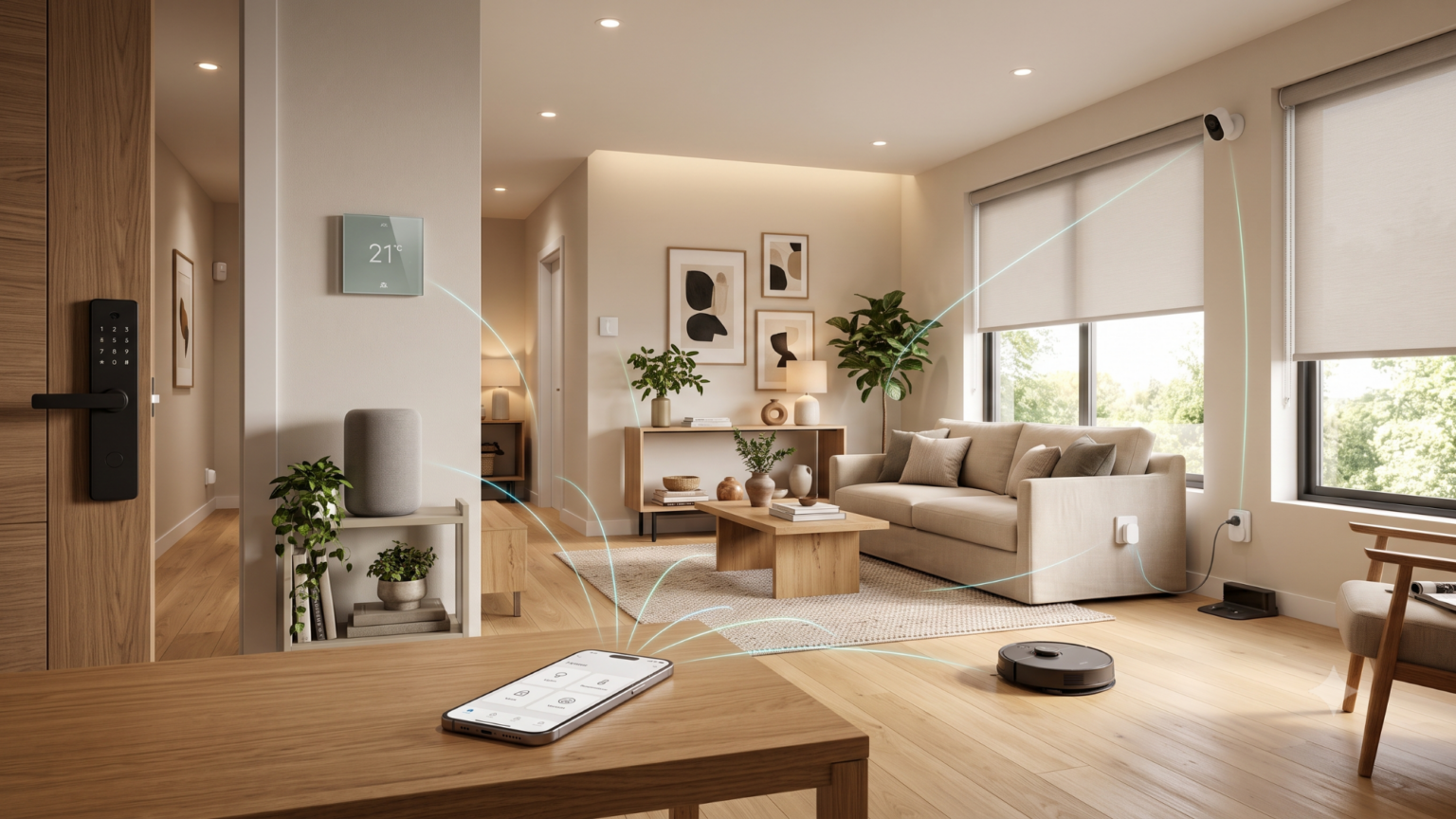
Building a smart home used to involve choosing one ecosystem and hoping every future device would work with it. A smart bulb might support one voice assistant, while a lock, thermostat, or sensor required a completely different application and hub.
Matter compatible smart home devices are designed to reduce this confusion.
Matter is an Internet Protocol-based smart home connectivity standard developed through the Connectivity Standards Alliance. Its purpose is to help certified devices from different manufacturers communicate through a shared standard instead of depending entirely on separate, brand-specific integrations.
A Matter-certified product may be usable with major platforms such as Apple Home, Amazon Alexa, Google Home, and Samsung SmartThings, provided the chosen platform supports that particular device category and feature.
This does not mean every Matter product will offer identical features on every platform. However, it creates a more consistent foundation for device setup, local communication, automation, and multi-platform control.
For homeowners planning a new connected home or replacing older products, understanding Matter can help prevent compatibility problems and reduce dependence on a single manufacturer.
What Is Matter in a Smart Home?
Matter is a connectivity standard rather than a smart home application, voice assistant, or wireless radio.
It provides a shared language that compatible smart home products and control platforms can use to communicate.
Matter works over established networking technologies, including:
- Wi-Fi
- Ethernet
- Thread
- Bluetooth Low Energy during many setup processes
- NFC for supported onboarding methods
Wi-Fi and Ethernet are commonly used by devices that require greater bandwidth or a constant power supply. Thread is a low-power mesh networking technology particularly suited to sensors, locks, plugs, switches, and other devices that may need efficient, responsive communication.
Matter does not replace platforms such as Alexa, Apple Home, Google Home, or SmartThings. Instead, it helps compatible products connect with these ecosystems through a standard method.
The result is intended to be a smart home where consumers can choose products based on features, quality, and price rather than being restricted to one brand.
What Does “Matter Compatible” Actually Mean?
The phrase “Matter compatible” should indicate that the product can participate in a Matter smart home network.
However, buyers should look specifically for the official Matter certification logo rather than relying only on vague statements such as “works with smart homes” or “Matter ready.”
A certified product has been tested against relevant Matter requirements. Certified product models can also be listed through the Connectivity Standards Alliance’s certification resources.
Matter devices use digital credentials during setup to help controllers verify that the product is authentic and certified. Matter also uses encrypted communication and access-control mechanisms to protect connected devices.
Certification does not guarantee that every optional feature will appear in every application. A device may offer basic Matter controls through several platforms while retaining advanced settings inside the manufacturer’s own app.
For example, a smart light may support on/off controls, brightness, and color through Matter, while specialised effects, firmware settings, or energy reports remain available only in its original application.
Common Types of Matter Compatible Smart Home Devices
The number of supported device categories has expanded since Matter’s original release. The following categories are among the most useful for everyday homes.
1. Smart Lights and Bulbs
Smart lighting is one of the easiest ways to begin using Matter.
Matter compatible lighting products may include:
- Standard smart bulbs
- Colour-changing bulbs
- Dimmable lights
- Light strips
- Ceiling fixtures
- Smart lamps
- In-wall lighting controls
Depending on the product and platform, users may be able to turn lights on or off, adjust brightness, change colour temperature, create routines, and include lighting in household automations.
A simple automation could turn hallway lights on when a motion sensor detects activity after sunset. Another routine could switch off downstairs lighting when the household activates a bedtime scene.
Matter lighting can connect through Wi-Fi, Thread, or a compatible bridge, depending on the manufacturer.
2. Smart Plugs and Electrical Outlets
Smart plugs provide an affordable way to add remote control and automation to ordinary electrical devices.
A Matter compatible smart plug can be used with lamps, fans, coffee machines, decorative lighting, and other suitable appliances.
Common functions include:
- Remote power control
- Scheduled operation
- Voice commands
- Inclusion in automation routines
- Power-status reporting
- Energy monitoring on supported models and platforms
Not every appliance should be connected to a smart plug. Devices with high electrical loads, heating elements, motors, or important safety requirements must remain within the plug manufacturer’s rated specifications.
Homeowners comparing connected products can also explore these smart appliances worth buying for modern homes before deciding whether smart control provides a genuine everyday benefit.
3. Smart Switches and Dimmers
Smart switches allow users to control installed lighting without replacing every individual bulb.
They are particularly useful in rooms containing multiple ceiling lights or fixtures that are difficult to access.
Matter compatible switches may include:
- On/off wall switches
- Dimmer switches
- Wireless buttons
- Scene controllers
- In-wall relay modules
- Mounted load controls
Before purchasing an in-wall switch, check whether the installation requires a neutral wire, what electrical load it supports, and whether professional installation is recommended.
The switch should also remain physically usable when the network or smart home controller is unavailable.
4. Smart Locks
Matter compatible smart locks can allow authorised users to lock or unlock a door through supported applications, voice assistants, automations, or physical access methods.
Depending on the model, access methods may include:
- Keypad codes
- Fingerprint recognition
- Mobile applications
- Physical keys
- NFC
- Temporary guest access
- Automated locking
Matter provides the connectivity foundation, but lock features still differ significantly between models.
Before buying, examine battery life, door compatibility, emergency access, weather resistance, installation requirements, and the manufacturer’s security-update policy.
Remote access normally requires a compatible controller in the home with an internet connection.
5. Thermostats and HVAC Controls
Matter compatible thermostats can connect heating and cooling systems with multiple smart home platforms.
Common controls may include:
- Temperature adjustment
- Heating and cooling modes
- Schedules
- Occupancy-based routines
- Energy-saving automations
- Humidity or comfort settings
- Remote control
Matter 1.6 introduced a standardised thermostat-suggestion feature. It allows ecosystems to send recommended, time-limited adjustments that a thermostat can evaluate against user preferences and current conditions rather than treating every request as a direct command.
Product and platform support for newer Matter 1.6 features will depend on manufacturers’ implementation schedules.
6. Sensors
Sensors are essential because they provide information that other devices can use for automation.
Matter compatible sensors can include:
- Motion sensors
- Contact sensors
- Temperature sensors
- Humidity sensors
- Occupancy sensors
- Light-level sensors
- Air-quality sensors
- Water-leak sensors
- Smoke and carbon monoxide alarms
- Soil-moisture sensors
A contact sensor could notify the household when a window is left open. A motion sensor could activate a light. A water-leak sensor could send an alert and work with a compatible valve to reduce damage.
Battery-powered Matter sensors frequently use Thread because it is designed for low-power mesh communication.
7. Smart Blinds and Window Coverings
Matter compatible window coverings may include blinds, curtains, shades, awnings, and other motorised closure products.
Supported controls can include:
- Opening and closing
- Percentage-based positioning
- Scheduled movement
- Voice control
- Sunrise and sunset routines
- Temperature-related automations
Matter 1.5 expanded the standard’s approach to closures, including more flexible ways to describe products such as shades, gates, garage doors, and multi-panel systems.
Actual availability depends on whether device manufacturers and smart home platforms have adopted those capabilities.
8. Smart Fans and Air-Quality Products
Matter can support connected fans, air purifiers, room air conditioners, and environmental sensors.
Depending on the device, users may be able to control:
- Power
- Fan speed
- Operating mode
- Air-quality routines
- Target temperature
- Automatic responses to sensor readings
A useful automation might increase ventilation when indoor air quality declines or switch an air purifier to a quieter mode at bedtime.
Smart operation should complement efficient product selection rather than replace it. The guide to energy-efficient home appliances explains additional factors such as appliance size, operating costs, maintenance, and responsible usage.
9. Household Appliances
Matter support has expanded into major home appliances, although platform support may vary.
Supported or developing categories include:
- Refrigerators
- Dishwashers
- Washing machines
- Dryers
- Ovens
- Cooktops
- Extractor hoods
- Microwave ovens
- Robot vacuum cleaners
Matter does not make dangerous appliance actions automatically available through every platform. Manufacturers and ecosystems can apply safety limitations to remote controls.
For example, an app may show an oven’s status but restrict remote activation unless specific safety conditions are met.
10. Security Cameras and Video Doorbells
Matter 1.5 introduced specification support for cameras.
The standard includes foundations for features such as:
- Live video
- Audio streaming
- Two-way communication
- Pan, tilt, and zoom
- Privacy zones
- Multiple streams
- Local or cloud recording options
However, specification support does not mean every camera or major ecosystem already offers full Matter camera compatibility.
Consumers must check the exact camera model, its certification status, the required Matter version, and support from their chosen control platform.
Matter Controllers and Thread Border Routers
A Matter device usually requires a Matter controller.
A controller is the product or platform responsible for adding, managing, and controlling Matter devices. It may be built into a smart speaker, display, home hub, television, streaming device, mobile platform, or dedicated controller.
Thread-based Matter devices also require a Thread border router.
A Thread border router connects the low-power Thread mesh network to the home’s regular IP network. Some smart speakers, routers, hubs, displays, and streaming devices include this functionality, but not every Matter controller is also a Thread border router.
Before buying a Matter-over-Thread device, verify that your home already has a compatible Thread border router or include one in the budget.
Matter Over Wi-Fi vs Matter Over Thread
Matter over Wi-Fi is commonly suitable for devices with constant power and higher data requirements.
Examples may include:
- Cameras
- Smart plugs
- Appliances
- Smart speakers
- Some bulbs
- Video devices
Matter over Thread is commonly suitable for low-power devices such as:
- Sensors
- Locks
- Buttons
- Switches
- Thermostats
- Blinds
Thread creates a mesh in which compatible powered devices can help extend the network. This can improve coverage when the network contains enough well-positioned Thread devices.
Neither option is automatically better in every situation. The correct choice depends on power requirements, bandwidth, installation location, and the existing home network.
Can One Matter Device Work With Multiple Platforms?
One of Matter’s most valuable features is multi-admin support.
Multi-admin allows a compatible device to be shared with more than one authorised smart home ecosystem.
For example, one household member may prefer Apple Home while another uses Google Home or Alexa. A supported Matter device can potentially appear in both ecosystems without requiring two separate physical devices.
Matter 1.6 also introduced Joint Fabric, a new approach through which multiple authorised controllers can co-manage a shared Matter network.
As with other recent features, Joint Fabric adoption will depend on platform and device support.
Are Older Zigbee and Z-Wave Devices Obsolete?
Existing smart home devices do not automatically become useless because they do not support Matter.
Matter can use bridges that bring compatible Zigbee, Z-Wave, or manufacturer-specific products into a Matter ecosystem.
A bridge translates between the older device network and Matter.
This approach can protect an existing investment in bulbs, switches, sensors, and accessories. However, bridged devices may not expose every advanced feature through Matter.
Before replacing an existing system, check whether its current hub has received or is scheduled to receive Matter bridge support.
How to Choose Matter Compatible Smart Home Devices
Use the following checklist before purchasing:
- Look for official certification: Check for the Matter logo and confirm the exact model, not merely the product family.
- Check your preferred ecosystem: Confirm that Apple Home, Alexa, Google Home, SmartThings, or another selected platform supports the device category.
- Identify the connection type: Determine whether the product uses Wi-Fi, Ethernet, Thread, or a bridge.
- Check controller requirements: Verify that you have a suitable Matter controller.
- Confirm Thread support: Matter-over-Thread products require a Thread border router.
- Review core and advanced features: Basic Matter controls may differ from features available in the manufacturer’s application.
- Check update support: Select brands with a clear policy for firmware updates and security patches.
- Consider local operation: Understand which controls work locally and which functions require cloud services.
- Review privacy policies: Matter provides secure communication, but manufacturers’ apps and cloud services still have their own data practices.
- Buy for a real purpose: A smart device should improve safety, comfort, energy use, accessibility, or convenience.
For more practical home and appliance guides, readers can explore Zingyzon.com.
Advantages of Matter Compatible Devices
The main potential benefits include:
- Greater choice between manufacturers
- Easier cross-platform integration
- Local device communication
- Faster basic controls
- Multi-ecosystem sharing
- Standardised setup
- Reduced dependence on proprietary integrations
- Better long-term flexibility
- A growing range of supported device categories
Matter can make smart homes simpler, but it does not eliminate the need to compare hardware quality, application design, warranty coverage, privacy policies, and manufacturer support.
Current Limitations of Matter
Matter remains an evolving standard.
Important limitations include:
- Platform support can lag behind the newest Matter specification.
- Not every device category is equally mature.
- Optional features may work differently between platforms.
- Some advanced controls still require the manufacturer’s app.
- Older devices need a compatible bridge or firmware update.
- Thread devices require appropriate network infrastructure.
- A Matter logo does not guarantee that every household ecosystem supports every feature.
- Remote control may still require an internet-connected hub or cloud service.
Matter 1.6 was released on June 17, 2026. It focuses on improved setup, coordinated multi-ecosystem management, thermostat suggestions, device capability reporting, and security-related refinements rather than adding a large group of new product categories.
Consumers should therefore compare the Matter specification supported by the product with the features currently implemented by their preferred platform.
Final Thoughts
Matter compatible smart home devices provide a stronger foundation for creating a connected home without becoming completely locked into one manufacturer.
Lights, plugs, switches, locks, thermostats, sensors, blinds, appliances, air-quality products, and newer camera systems can all benefit from standardised communication.
However, the Matter logo should be the beginning of the buying process rather than the only factor considered.
Check the device category, platform support, connectivity method, controller requirements, Thread border-router needs, update policy, and available functions.
The best smart home is not the one with the largest number of connected products. It is the one in which each device solves a clear problem and continues working reliably as the home expands.
By selecting certified products carefully and building the system gradually, homeowners can create a more flexible, responsive, and future-ready smart home.
Frequently Asked Questions
What are Matter compatible smart home devices?
They are smart home products designed or updated to communicate through the Matter connectivity standard. Certified devices can work with supported Matter controllers and ecosystems.
Do Matter devices need a hub?
They require a Matter controller, which may already be built into a compatible smart speaker, display, television, router, streaming device, or home hub. Thread devices also need a Thread border router.
Does Matter work without the internet?
Many basic Matter controls can operate locally. Remote access, manufacturer applications, cloud recordings, voice services, and some advanced functions may still require an internet connection.
Can Matter devices work with Alexa and Apple Home at the same time?
Matter’s multi-admin feature can allow supported devices to be shared with multiple authorised ecosystems. Compatibility still depends on each platform supporting the specific device category.
Is Thread the same as Matter?
No. Matter is the smart home communication standard, while Thread is one of the networking technologies over which Matter can operate.
Can old smart home devices be upgraded to Matter?
Some existing devices can receive Matter through firmware updates. Others may connect through a compatible bridge. Whether an upgrade is available depends on the hardware and manufacturer.
Are all Matter devices fully compatible with every platform?
Not necessarily. Basic controls may work across several platforms, but device categories, Matter versions, optional features, and advanced functions can differ.


Keep Exploring Zingyzon.com
Read more Zingyzon SEO, digital marketing, online earning, business, and technology guides for Australia, USA, and global readers.