
Cracking the Logic Gates: Why You Need a Digital Computer Science Coach
Computer science can look straightforward from the outside. You write instructions, run a program, and expect the computer to respond. […]
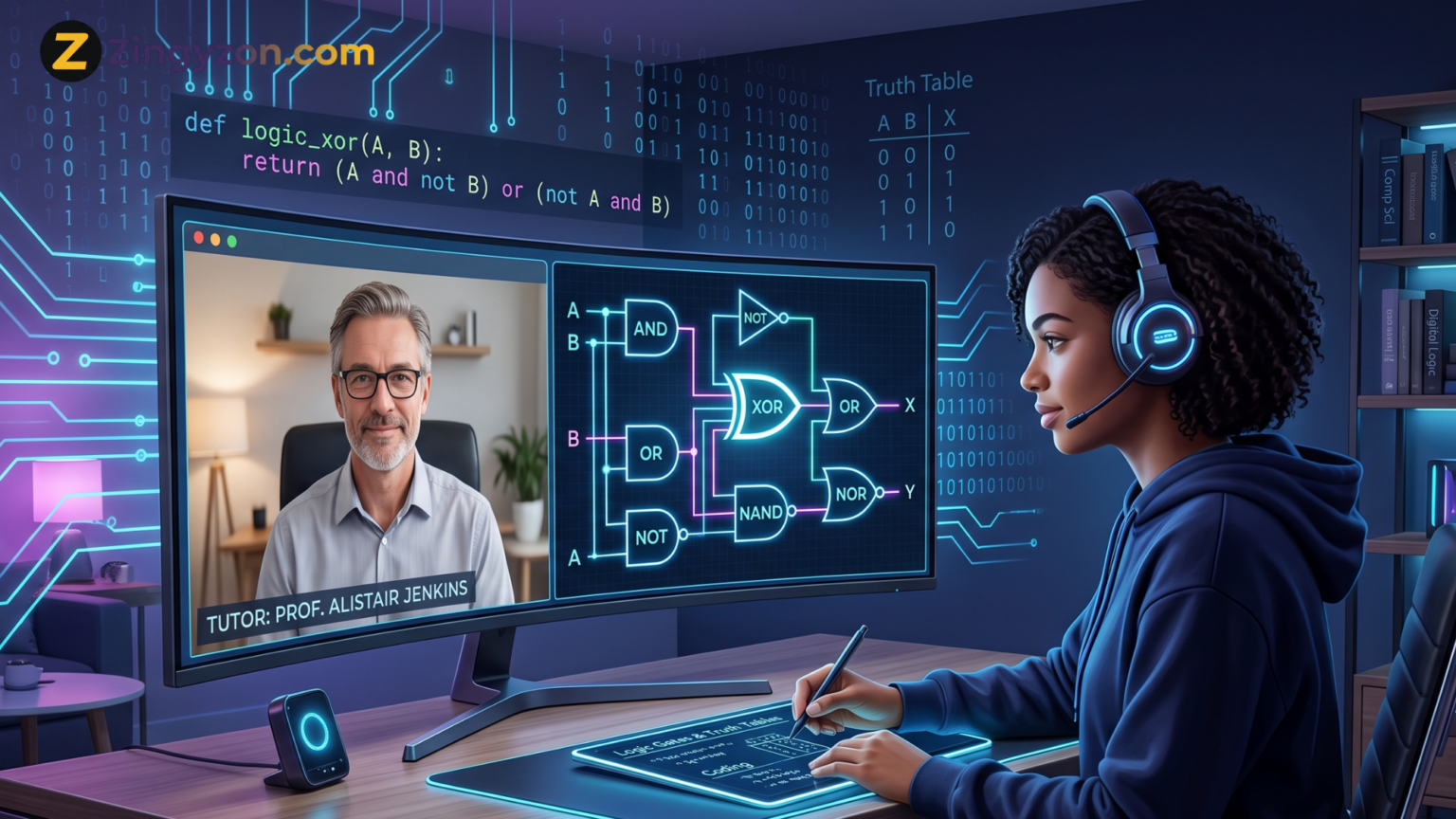
Computer science can look straightforward from the outside. You write instructions, run a program, and expect the computer to respond. In practice, the subject requires logical thinking, patience, problem-solving, and the ability to understand systems that may not be visible.
For many learners, the first serious challenge appears when they meet logic gates, Boolean algebra, truth tables, binary numbers, algorithms, or programming conditions. These concepts are essential, but they can feel abstract when they are explained too quickly or taught only through textbooks and recorded videos.
A digital computer science coach can make the learning process clearer and more practical. Rather than asking students to memorize rules, a coach helps them understand why a system works, how to break a problem into smaller steps, and how to test their reasoning.
This article explains why personalized digital coaching can improve computer science learning, strengthen confidence, and help students become more independent problem-solvers.
What Is a Digital Computer Science Coach?
A digital computer science coach is an online educator or mentor who provides personalized guidance in computer science. Sessions may take place through video calls, screen sharing, digital whiteboards, coding platforms, or interactive exercises.
Unlike a pre-recorded course, coaching is responsive. The learner can ask questions, show their work, explain where they are confused, and receive feedback immediately.
A coach may support logic gates, programming, algorithms, data structures, databases, networking, computer architecture, exam preparation, and coding projects. The aim is to teach the learner how to understand a question, choose a method, test the solution, and explain the answer clearly.
The coach does not simply provide solutions. Instead, the learner is guided through the process so they can understand how the answer was reached and apply the same method to future problems.
Why Logic Gates Can Feel So Difficult
Logic gates are often introduced as simple rules. An AND gate produces a true output when both inputs are true. An OR gate produces a true output when at least one input is true. A NOT gate reverses the input.
The difficulty grows when several gates appear in one circuit. Students must identify each symbol, track inputs, calculate intermediate outputs, follow the correct order, and connect the circuit to a Boolean expression or truth table.
A learner may understand each gate separately but still struggle with a full circuit. This usually means the explanation needs to be broken into smaller steps.
A digital computer science coach can label each stage, test one input combination at a time, and show how the final output is produced. Once the process is clear, logic gates begin to feel like a language the student can read.
For example, instead of solving a complete digital circuit at once, the coach may divide it into three smaller sections. The student calculates the output of the first gate, uses that result as an input for the next gate, and continues until the final output is reached.
This approach reduces confusion and helps learners understand how complex digital systems are built from simple logical decisions.
Personalized Learning Targets the Real Problem
Every student struggles with different parts of computer science. One learner may understand theory but find coding difficult. Another may write working programs but struggle to explain algorithms. Some students learn best through diagrams, while others need practical examples and repetition.
A classroom teacher has limited time to adjust every lesson for every learner. Digital coaching can focus directly on the area causing difficulty.
For example, a student who confuses OR and XOR can work through comparison exercises. A learner who understands truth tables but struggles with Boolean simplification can focus on Boolean laws. Someone who keeps creating infinite loops can trace variables and conditions until the mistake becomes clear.
This targeted approach saves time and strengthens the exact foundation preventing progress.
Instead of reviewing an entire course, a coach can identify the specific knowledge gap. Once that gap is fixed, the student often finds that other computer science topics become easier to understand.
Immediate Feedback Stops Small Errors From Growing
Self-study is useful, but it comes with a risk. Students may practise the wrong method without realizing it. A learner might misunderstand a Boolean rule, use the wrong data type, or write a condition that seems correct but fails with certain inputs.
A coach provides immediate feedback and identifies the exact step where the reasoning changed direction.
This is especially valuable in programming. A program may run without an obvious error but still produce the wrong result. A coach can help inspect values, test conditions, and trace the code. The student learns that debugging is a structured investigation, not random guessing.
Immediate feedback also prevents frustration. When students work alone, they may spend hours searching for a small mistake. A coach can help them understand the mistake and, more importantly, teach them how to identify similar problems independently.
Over time, students develop stronger checking habits and become more accurate in both programming and written computer science tasks.
Coaching Develops Computational Thinking
Computer science cannot be mastered through memorization alone. Programming languages change, software tools evolve, and exam questions often present familiar concepts in unfamiliar ways.
The most valuable skill is computational thinking. This means breaking large problems into smaller tasks, identifying patterns, ignoring unnecessary details, creating a logical sequence, and testing whether the solution works.
A strong coach encourages this process by asking useful questions:
- What information is already available?
- What result is required?
- Which condition controls the output?
- Can the problem be tested with a simpler example?
- What happens when the input changes?
These questions teach students how to approach problems independently and rely less on guidance over time.
Computational thinking is useful far beyond a single computer science lesson. It helps students organize information, evaluate possible solutions, and make better decisions when working on technical projects.
Why an Online Computer Science Tutor Can Be More Effective Than Random Tutorials
Free videos and articles can explain basic concepts, but they are designed for a broad audience. They cannot see whether a learner has misunderstood a step, and they cannot change the explanation when the first method does not work.
Working with an online computer science tutor creates a more focused experience. The tutor can adapt examples to the student’s age, course, programming language, exam board, or project requirements.
Live support is particularly helpful when a learner is caught between two ideas. For example, the student may understand loops but not know when to use a for loop instead of a while loop. A tutor can compare both approaches and demonstrate how each choice affects the program.
A tutor can also observe how the student approaches a problem. This makes it easier to identify whether the issue is related to subject knowledge, reading the question, planning the solution, or checking the final result.
This personalized guidance can reduce the amount of time students spend moving between unrelated tutorials that may use different terminology or teaching methods.
The Right Environment to Ask Questions Matters
Many students stay silent because they are afraid their question will sound too basic. In a busy classroom, they may not want to interrupt. During self-study, they may not know how to describe the problem.
Personal coaching can create the right environment to ask questions. The learner can pause the explanation, request another example, repeat a step, or test an idea without feeling rushed.
Questions reveal hidden gaps and help learners connect new ideas with existing knowledge. A supportive coach treats mistakes as useful information rather than a reason for judgment.
When students feel comfortable asking questions, they become more involved in the learning process. They are more likely to explain their reasoning, attempt challenging exercises, and discuss the parts they do not understand.
This creates active learning instead of passive listening.
Better Programming and Debugging Skills
Programming can be rewarding, but it can also be frustrating. A missing bracket, incorrect variable, wrong condition, or unexpected data type can stop a program from behaving correctly.
A coach can teach a reliable debugging routine:
- Read the error or unexpected output carefully.
- Identify the area of code involved.
- Check the values being used.
- Trace the program step by step.
- Change one thing at a time.
- Test the program again.
This method helps students remain calm and look for evidence. Coaching can also improve code quality through clearer structure, meaningful variable names, functions, and comments.
Students learn that writing code is only one part of programming. They must also test the code, check unusual inputs, improve readability, and make sure the program solves the original problem.
These habits are important for students who want to continue into software development, web development, data science, or other technical careers.
Stronger Preparation for Exams and Assessments
Computer science exams test more than definitions. Students may need to trace algorithms, complete truth tables, identify errors, write pseudocode, compare technologies, or explain how a system works.
A digital computer science coach can identify weak areas and build a focused study plan. Sessions may include timed questions, topic-based revision, pseudocode practice, Boolean logic, algorithm tracing, and feedback on written explanations.
Coaching also teaches learners to use accurate terminology, show their reasoning, and manage time effectively during assessments.
For example, a student may know the correct answer but lose marks because the explanation is incomplete. A coach can demonstrate how to structure the answer, include the required technical terms, and provide enough detail without writing unnecessary information.
Practising exam-style questions also helps students become familiar with different question formats and reduces anxiety before an assessment.
Confidence Grows Through Small Wins
Repeated difficulty can make students believe they are simply not good at computer science. That belief often develops because the learner has been asked to solve complex problems before mastering the smaller skills underneath them.
A coach can divide a difficult topic into achievable stages. With logic gates, a student might first identify symbols, then complete single-gate truth tables, analyze combined circuits, and finally simplify Boolean expressions.
Each successful step builds confidence by showing that difficult problems can be understood through a clear method and consistent practice.
The same approach can be used for programming. A beginner may start by displaying text, then work with variables, conditions, loops, functions, and complete programs.
Progress becomes easier to recognize when large goals are divided into smaller milestones.
Learn at a Pace That Matches Your Needs
Digital coaching gives learners more control over the pace of study. A difficult concept can receive extra attention, while familiar material can be reviewed quickly.
This flexibility is useful for school students, university learners, adult beginners, career changers, online course participants, and professionals improving technical skills.
Sessions can also be arranged around classes, work, or family responsibilities. Because computer science topics build on one another, personalized coaching lets learners return to weak foundations without embarrassment.
A student who does not understand binary numbers may later struggle with data representation. Someone who has difficulty with conditions may find loops and algorithms confusing.
Addressing these gaps early creates a stronger foundation for advanced topics.
Connecting Theory With Real Technology
Abstract topics become easier to remember when students understand where they are used.
Logic gates are part of processors, memory systems, control circuits, and digital devices. Binary is used to represent information inside computers. Algorithms control how data is searched, sorted, processed, and displayed. Data structures help software store information efficiently.
A coach can connect an if statement to a login system, a database lesson to an online store, or networking concepts to websites and video calls.
These examples show that computer science is the foundation of technology people use every day.
Understanding real-world applications also increases motivation. Students are more likely to engage with a topic when they can see how it connects to smartphones, games, websites, artificial intelligence, security systems, and digital communication.
How to Choose the Right Digital Computer Science Coach
Subject knowledge is important, but a coach must also be able to communicate clearly.
Look for someone who:
- Asks about your learning goals
- Understands your current skill level
- Explains concepts in multiple ways
- Uses practical examples and diagrams
- Encourages active problem-solving
- Provides clear and constructive feedback
- Gives structured practice activities
- Allows students to ask questions
- Understands the relevant curriculum
- Helps learners become independent
Sessions should have direction, and the learner should understand what is being studied, why it matters, and what progress has been made. Most importantly, good coaching should build independence.
The student should gradually become more confident in solving questions without assistance.
Why Digital Coaching Is a Long-Term Investment
The value of coaching goes beyond one exam. Students learn to break down problems, test solutions, manage frustration, and communicate technical ideas.
These skills are useful in software development, cybersecurity, data science, artificial intelligence, networking, and engineering.
Technology will continue to change. Learners who know how to think, investigate, test, and adapt will be better prepared than those who only memorize current tools.
Resources available through zingyzon.com can help learners follow a clearer and more guided path through technical subjects.
Investing in guided learning can also save time. Instead of spending weeks struggling with the same topic, students can identify the problem, understand the correct method, and continue building their skills.
Final Thoughts
Logic gates may be the point where computer science starts to feel complicated, but they are also an opportunity to build stronger logical thinking.
A digital computer science coach provides personal explanations, immediate feedback, guided practice, and a supportive space for questions. This can turn abstract diagrams into understandable systems, coding errors into learning opportunities, and difficult assignments into manageable steps.
Students do not need someone to provide every answer. They need guidance that shows them how to find the answer, explain the reasoning, and apply the same process again.
With consistent practice and the right support, computer science becomes less intimidating and far more rewarding.
Frequently Asked Questions
What does a digital computer science coach teach?
A coach may teach logic gates, programming, algorithms, data structures, databases, networking, computer architecture, exam preparation, and project development. The exact topics depend on the learner’s level and goals.
Can beginners work with a computer science coach?
Yes. Beginners often benefit greatly because a coach can build strong foundations and correct misunderstandings before they become habits.
Is online coaching useful for logic gates?
Yes. Screen sharing, digital whiteboards, circuit diagrams, and live truth-table exercises make logic gates easier to explain and practise.
Can coaching improve programming confidence?
Yes. Guided coding, structured debugging, and immediate feedback help students understand errors instead of fearing them.
Will a coach complete assignments for the student?
A responsible coach should explain the concepts and guide the learner through the process. The goal is to help the student complete future work independently.
Keep Exploring Zingyzon.com
Read more Zingyzon SEO, digital marketing, online earning, business, and technology guides for Australia, USA, and global readers.