
Hexarelin Peptide Explained: Mechanisms and Research Perspectives
Hexarelin peptide has attracted attention across endocrine, metabolic, cardiovascular, and aging research. It is a synthetic growth hormone-releasing peptide, or […]
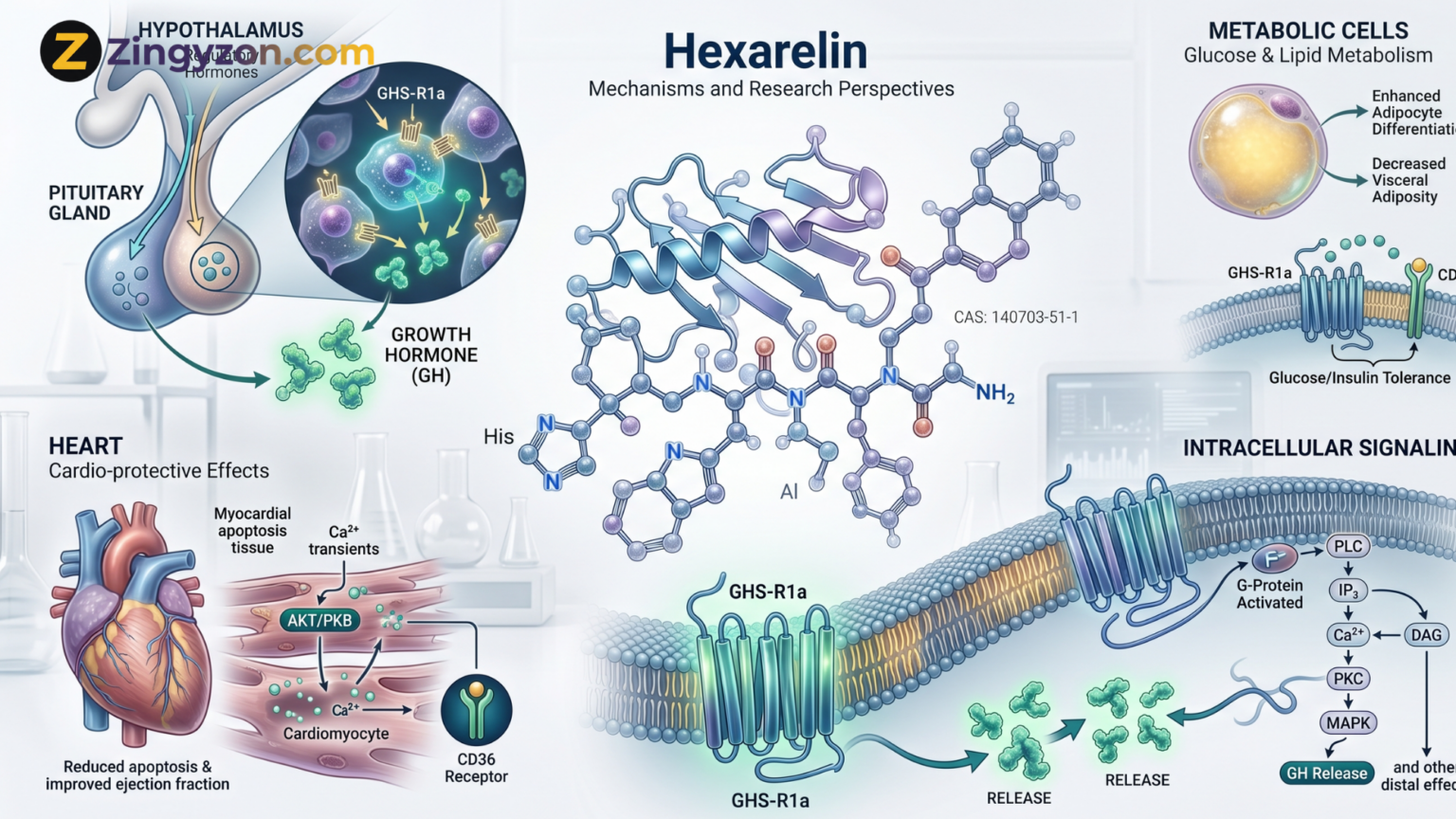
Hexarelin peptide has attracted attention across endocrine, metabolic, cardiovascular, and aging research. It is a synthetic growth hormone-releasing peptide, or GHRP, that activates the growth hormone secretagogue receptor. This receptor is also called the ghrelin receptor because ghrelin is its natural ligand.
Hexarelin is often described simply as a compound that increases growth hormone. Its scientific relevance is broader, yet many online claims extend beyond the available evidence. This guide from zingyzon.com explains its mechanism, major research areas, evidence limits, and safety questions. It is educational and does not present Hexarelin as an approved medicine, supplement, bodybuilding aid, or treatment.
What Is Hexarelin Peptide?
Hexarelin, also called examorelin, is a synthetic hexapeptide. The term “hexapeptide” means that the molecule contains six amino-acid residues. It belongs to the growth hormone secretagogue family, a group of compounds developed to stimulate the release of growth hormone through pathways that differ from the classical growth hormone-releasing hormone receptor.
Hexarelin is not growth hormone itself. Instead, it acts as a signal that can encourage specialized pituitary cells, called somatotrophs, to release stored growth hormone. This distinction is essential because direct hormone administration and secretagogue-driven hormone release do not produce identical biological patterns.
In commercial scientific catalogs, Hexarelin may be grouped under the broad label Research Peptide. That category describes how a supplier markets a substance, not proof of clinical effectiveness, pharmaceutical approval, or suitability for human use. Researchers must still evaluate identity, purity, handling standards, study design, and legal requirements independently.
The U.S. Food and Drug Administration’s substance database lists Hexarelin as a synonym of examorelin. However, the presence of a substance in an FDA identification database does not mean that the agency has approved it as a drug. Regulatory identity and medical authorization are separate matters.
How Does Hexarelin Work?
Binding to the Growth Hormone Secretagogue Receptor
Hexarelin’s best-established target is growth hormone secretagogue receptor type 1a, or GHS-R1a. This seven-transmembrane G-protein-coupled receptor is strongly expressed in the hypothalamus and pituitary gland, although receptor activity and related binding sites have also been investigated in peripheral tissues.
After Hexarelin binds GHS-R1a, signaling commonly involves phospholipase C, inositol trisphosphate, diacylglycerol, protein kinase C, and increased intracellular calcium. The calcium signal helps pituitary somatotrophs release stored growth hormone.
This differs from the growth hormone-releasing hormone receptor, which mainly signals through cyclic AMP and protein kinase A. Because the pathways are partly distinct, GHRH and growth hormone secretagogues can produce synergistic responses in some experiments.
Pituitary and Hypothalamic Effects
Hexarelin appears to work at both levels of the hypothalamic-pituitary axis. It can stimulate pituitary somatotrophs directly, while growth hormone secretagogues may also enhance GHRH-neuron activity and functionally oppose somatostatin, the hormone that suppresses growth hormone release.
The result depends on age, baseline endocrine function, nutrition, receptor activity, previous exposure, and natural hormone pulsatility. Early human studies reported a rapid growth hormone rise after intravenous Hexarelin, while later work examined repeated exposure and interaction with GHRH.
The commercial phrase Human Growth Hormone Peptide can be misleading. Scientifically, Hexarelin is a growth hormone-releasing peptide, not human growth hormone itself.
Hexarelin and the GH–IGF-1 Axis
Growth hormone affects numerous tissues directly, but many of its longer-term growth-related effects are mediated through insulin-like growth factor 1, or IGF-1. The liver is a major source of circulating IGF-1, although many tissues also produce it locally.
An acute Hexarelin-induced growth hormone pulse does not automatically prove a meaningful or sustained increase in IGF-1. Duration, frequency, dose, route, receptor responsiveness, and feedback regulation all matter. In some repeated-administration studies, growth hormone responsiveness changed over time, and sustained changes in downstream hormones were not always demonstrated.
This is one reason laboratory findings should not be translated casually into claims about muscle growth, fat loss, recovery, or “anti-aging.” A measurable endocrine response is biologically interesting, but it is not the same as a proven clinical benefit.
Desensitization and Reduced Responsiveness
One important research question is whether repeated stimulation causes tachyphylaxis or desensitization. Tachyphylaxis refers to a rapidly diminishing response after repeated exposure. Receptor internalization, altered signaling proteins, depletion of readily releasable hormone stores, and negative feedback from the GH–IGF-1 axis may all contribute.
Studies involving repeated Hexarelin administration have reported attenuation of the growth hormone response under some conditions. The pattern is not necessarily complete or permanent, and it may differ according to timing and study population. Nevertheless, it shows why a strong response to a single experimental exposure cannot be projected indefinitely.
Desensitization is also relevant when researchers compare Hexarelin with other secretagogues. A compound’s initial potency is only one variable. Selectivity, duration, endocrine spillover, receptor adaptation, and downstream biological outcomes can be equally important.
Endocrine Effects Beyond Growth Hormone
Hexarelin is often described primarily as a growth hormone secretagogue, but human studies indicate that it is not perfectly selective. It can also increase prolactin, adrenocorticotropic hormone, and cortisol under certain experimental conditions.
ACTH is released by the pituitary and stimulates cortisol production by the adrenal glands. Cortisol is central to stress physiology, glucose regulation, immune signaling, and blood-pressure control. Therefore, stimulation of the ACTH–cortisol axis complicates any simplistic description of Hexarelin as a narrowly targeted growth hormone compound.
Research has also found that endocrine responses can vary with age. Growth hormone release generally changes across the lifespan, and the responses of prolactin, ACTH, and cortisol do not necessarily follow the same pattern. These differences suggest that several mechanisms or receptor populations may contribute.
The available evidence does not establish that these additional hormonal effects are beneficial. Instead, they represent variables that must be monitored carefully in experimental design and safety assessment.
Cardiovascular Research Perspectives
Hexarelin became a cardiovascular research target after growth hormone secretagogue binding activity was identified in heart and vascular tissues. Animal, isolated-tissue, and cell studies have examined cardiac contractility, blood-vessel function, inflammation, cell survival, and recovery after ischemic injury.
Some preclinical models of myocardial infarction, heart failure, or ischemia-reperfusion injury reported improved ventricular performance or reduced cellular damage. These findings are scientifically interesting, but they do not prove clinical benefit in people.
Not every reported action appears to depend only on GHS-R1a. Hexarelin has also been studied in relation to CD36, a scavenger receptor involved in fatty-acid handling, oxidized lipoprotein uptake, macrophage biology, and inflammation. Experimental work suggests possible changes in cholesterol transport pathways involving ABCA1 and ABCG1. However, cellular effects cannot establish that Hexarelin prevents atherosclerosis or heart disease.
Human cardiovascular evidence remains insufficient. Growth hormone signaling, cortisol, glucose, fluid balance, and blood pressure could all influence net risk. Hexarelin is therefore better described as an experimental cardiovascular probe than a proven cardioprotective therapy.
Metabolic and Pancreatic Research
The ghrelin receptor system participates in appetite, glucose homeostasis, lipid metabolism, gastrointestinal function, and energy balance. Because Hexarelin activates this system, researchers have examined possible effects on insulin release, insulin sensitivity, pancreatic beta cells, and fat metabolism.
Preclinical reviews discuss potential protective or regenerative effects in pancreatic models. Other studies of growth hormone secretagogues raise concerns about glucose control because growth hormone can oppose insulin action. The direction of the net effect may depend on the model, tissue, exposure pattern, disease state, and balance between direct receptor signaling and secondary hormone changes.
Claims that Hexarelin reliably “burns fat” or improves insulin sensitivity are therefore premature. Lipolysis can increase under growth hormone signaling, but changes in circulating fatty acids do not automatically translate into safe weight reduction or improved metabolic health.
NAD+ is a separate molecule involved in cellular redox reactions and energy metabolism. Commercial searches may lead readers to pages using phrases such as Buy Nad+ 100mg. However, NAD+ and Hexarelin act through different biological systems, and claims of synergy should require direct, controlled evidence rather than assumptions based on general “energy” or “recovery” language.
Neurobiology, Sleep, and the Stress Axis
GHS-R1a is expressed in brain regions involved in appetite, reward, learning, memory, and neuroendocrine regulation. Ghrelin research has generated interest in neuroprotection and cognitive function. However, evidence about ghrelin cannot automatically be assigned to Hexarelin, even though both can activate the same receptor.
Direct human Hexarelin research in neurobiology is limited. One small sleep study in healthy volunteers reported changes in slow-wave sleep alongside increases in growth hormone, ACTH, cortisol, and prolactin. This finding illustrates that endocrine stimulation may affect sleep architecture in ways that are not necessarily restorative or beneficial.
Preclinical hypotheses involving neuroinflammation, neuronal survival, or age-related cognitive decline remain research questions. At present, Hexarelin should not be described as a proven treatment for Alzheimer’s disease, Parkinson’s disease, memory impairment, depression, or chronic stress.
Musculoskeletal and Aging Research
Growth hormone and IGF-1 influence protein metabolism, bone remodeling, connective tissue, and body composition. Consequently, Hexarelin is frequently discussed in relation to muscle, bone, recovery, and aging.
The biological rationale is understandable: stimulate endogenous growth hormone, potentially influence IGF-1, and then examine downstream tissue responses. Yet clinical outcomes cannot be inferred from pathway activation alone. Muscle strength, fracture risk, tendon healing, physical function, and healthy longevity are complex endpoints requiring controlled human trials.
Age also changes the responsiveness of the growth hormone axis. Older adults may show a different response from younger participants, while age-related vulnerability to glucose disruption, edema, cardiovascular stress, or hormonal imbalance may alter the risk-benefit profile.
For these reasons, phrases such as “anti-aging peptide,” “muscle-building compound,” or “recovery accelerator” exceed the established evidence. A responsible research perspective separates plausible mechanisms from proven outcomes.
Hexarelin Compared With Other Secretagogues
Hexarelin belongs to a wider group that includes GHRP-2, GHRP-6, ipamorelin, and several nonpeptide secretagogues. They share receptor-related biology but differ in potency, selectivity, pharmacokinetics, appetite effects, and influence on prolactin or the ACTH–cortisol axis.
Hexarelin has often produced a strong acute growth hormone response in experimental studies. However, calling it the “strongest” or “best” is not scientifically sufficient. A useful comparison should ask several questions:
- How selective is the compound for growth hormone release?
- Does it alter prolactin, ACTH, cortisol, appetite, or glucose?
- How quickly does receptor responsiveness decline?
- Are findings based on cells, animals, healthy volunteers, or patients?
- Is the measured endpoint a hormone concentration or a meaningful health outcome?
- Has long-term safety been established?
Without those distinctions, comparisons can become promotional rather than scientific.
Safety, Regulatory Status, and Research Quality
Hexarelin is not an FDA-approved treatment. An FDA substance identifier confirms chemical identity, not approval, effectiveness, or safety. Products sold as “research use only” are also not reviewed like approved medicines for consistent clinical quality.
Potential concerns include endocrine disruption, increased cortisol or prolactin, altered glucose regulation, appetite changes, fluid-related effects, injection-related complications, contamination, incorrect labeling, immune reactions, and unknown long-term consequences. The true risk profile remains uncertain because robust, modern, long-duration human trials are lacking.
Compounded and unapproved peptide products deserve particular caution. The FDA explains that compounded drugs are not FDA approved and are not reviewed for safety, effectiveness, or quality before marketing. A supplier’s certificate, purity claim, or research disclaimer does not replace independent analytical verification or regulatory oversight.
Hexarelin is also prohibited in sport under the World Anti-Doping Agency’s category covering growth hormone-releasing factors and peptides. Competitive athletes should not assume that a “research” label prevents an anti-doping violation.
Good research requires authenticated material, validated analytical methods, appropriate controls, ethical approval, transparent reporting, and careful separation of exploratory findings from clinical conclusions. Researchers must also follow institutional, national, and local rules governing peptide procurement, storage, and experimental use.
Key Gaps in Hexarelin Research
Despite decades of investigation, several basic questions remain unresolved. Researchers still need larger and more diverse human studies, standardized outcome measures, clearer pharmacokinetic data, and direct comparisons with related secretagogues.
Long-term cardiovascular and metabolic safety is especially important. Another gap is the distinction between receptor-mediated effects and secondary changes caused by growth hormone, IGF-1, cortisol, prolactin, or appetite. Researchers also need better evidence about sex differences, age-related responses, disease-specific effects, and receptor desensitization.
Finally, many claims circulating online are based on mechanistic extrapolation. Future studies should focus not only on whether Hexarelin changes a laboratory marker, but whether that change produces a meaningful, reproducible, and safe outcome.
Frequently Asked Questions
Is Hexarelin human growth hormone?
No. It is a secretagogue that can stimulate the pituitary to release endogenous growth hormone.
Is Hexarelin FDA approved?
No. An FDA substance identifier confirms chemical identity, not approval, safety, or effectiveness.
Does it build muscle or protect the heart?
Those claims are unproven. Mechanistic and preclinical findings do not establish safe clinical benefits.
Can it affect other hormones?
Yes. Human experiments have reported increases in prolactin, ACTH, and cortisol.
Is it prohibited in sport?
Yes. WADA lists examorelin, or Hexarelin, among prohibited growth hormone-releasing peptides.
Conclusion
Hexarelin peptide is a valuable research tool for studying growth hormone secretagogue signaling. Its primary mechanism involves activation of GHS-R1a, followed by intracellular calcium signaling and growth hormone release. It may also interact with hypothalamic regulation, GHRH activity, somatostatin tone, cardiovascular receptors, metabolic pathways, and the stress-hormone axis.
The scientific picture, however, is not equivalent to the promotional one. Strong acute growth hormone release does not prove long-term improvement in muscle, fat loss, aging, cognition, heart health, or recovery. Cardiovascular and metabolic findings are intriguing but remain heavily dependent on preclinical evidence. Human studies are limited, while endocrine spillover and desensitization complicate the risk profile.
The most accurate perspective is therefore balanced: Hexarelin is biologically potent and scientifically interesting, but its therapeutic value and long-term safety remain unestablished. Future progress will depend on rigorous clinical research, transparent methodology, and careful distinction between molecular possibility and demonstrated medical benefit.



Keep Exploring Zingyzon.com
Read more Zingyzon SEO, digital marketing, online earning, business, and technology guides for Australia, USA, and global readers.